The truth is, I'm still processing it.
I had the z'chut to attend the annual hilula (celebration) of my Rebbe, Reb Kalonymous Kalman Shapira zya hyd this past motzei Shabbos. It was such an incredibly moving event, the intensity of it all is still so overwhelming that I constantly found my thoughts drifting back to the words that Rav Moshe Weinberger spoke.
This year, the hilula coincided with the debut of a new book that my good friend Binyomin Wolf put out. A collection of the ma'amarim Rav Weinberger gave over the last 15 years since the inception of the hilula in 2000, this slim volume serves not only as an introduction to the Torah of Piaseczna, but that of Rav Weinberger as well. It's a beautiful addition to the legacy of the Rebbe, a strong homage to the message of the Aish Kodesh.
I consider myself fortunate. Lucky to have been introduced the the writings of the Rebbe during a particularly difficult time in my life and then later on - through my efforts to share his work with others - discovering the fount of Torah wisdom that is Rav Weinberger. It's no coincidence that the same praise and gratitude that Rav Weinberger himself attributes to the Piaseczna is said about himself by others. In this year's ma'amar (indeed, the motivation behind the book) Rav Weinberger addressed the phenomenon we are witnessing that people from all walks of life - Jews and non-Jews alike - are drawn to the Torah of the Aish Kodesh in ever growing droves. Soul searchers, academics, meditation enthusiasts, philosophers, people from various streams of Judaism - all come to drink from the wellsprings of Reb Kalonymous Kalman. What is it about the Rebbe? What is the appeal? Rav Weinberger discusses this and more, and it can be listened to here.
For me, personally? As Rav Weinberger intimated, there are people who search for tzaddikim who can breathe life back into our souls. They feel deflated, defeated, lost in the chaos of a world moving at breakneck speed. They long to hear words of encouragement, to taste - briefly - the "dew of life" on their parched lips. They seek healing; some may be healers themselves, giving away their own vitality to others while wondering (doubting!) in the back of their mind whether they have anything to give.
I am such a person.
The Rebbe's writings - in the inimitable words of Rav Soloveitchik - address themselves to the reader's soul. Even if the passage itself is not relevant to my situation, the essence of the Rebbe permeates every word and touches me to my very core. His teaching are a touchstone for me, a guide for my daily living. And many times I don't internalize his words, and I don't feel worthy of considering myself a talmid, let alone a chassid. Still, because of who the Rebbe was, I can never stay far away from him. It is the conviction, the knowledge that the Rebbe is speaking directly to me from the perspective of one who has also suffered that comforts me when I'm confronted with the existential loneliness that we all share.
It's his words of fire and hope that illuminate my darkness, the same words that Rav Weinberger echoed in that darkened room this past motzei Shabbos.
It strengthens me, and I can take hold of myself once more and plunge back into the fray.
Showing posts with label Rebbe Nachman. Show all posts
Showing posts with label Rebbe Nachman. Show all posts
Thursday, October 22, 2015


Monday, October 20, 2014
ZUSHA: EP release announcement/review

I am pleased to help spread the word that ZUSHA is set to release their debut EP this coming week, October 28th; a special release party is scheduled for the Sunday prior to that with folk singer Levi Robin.
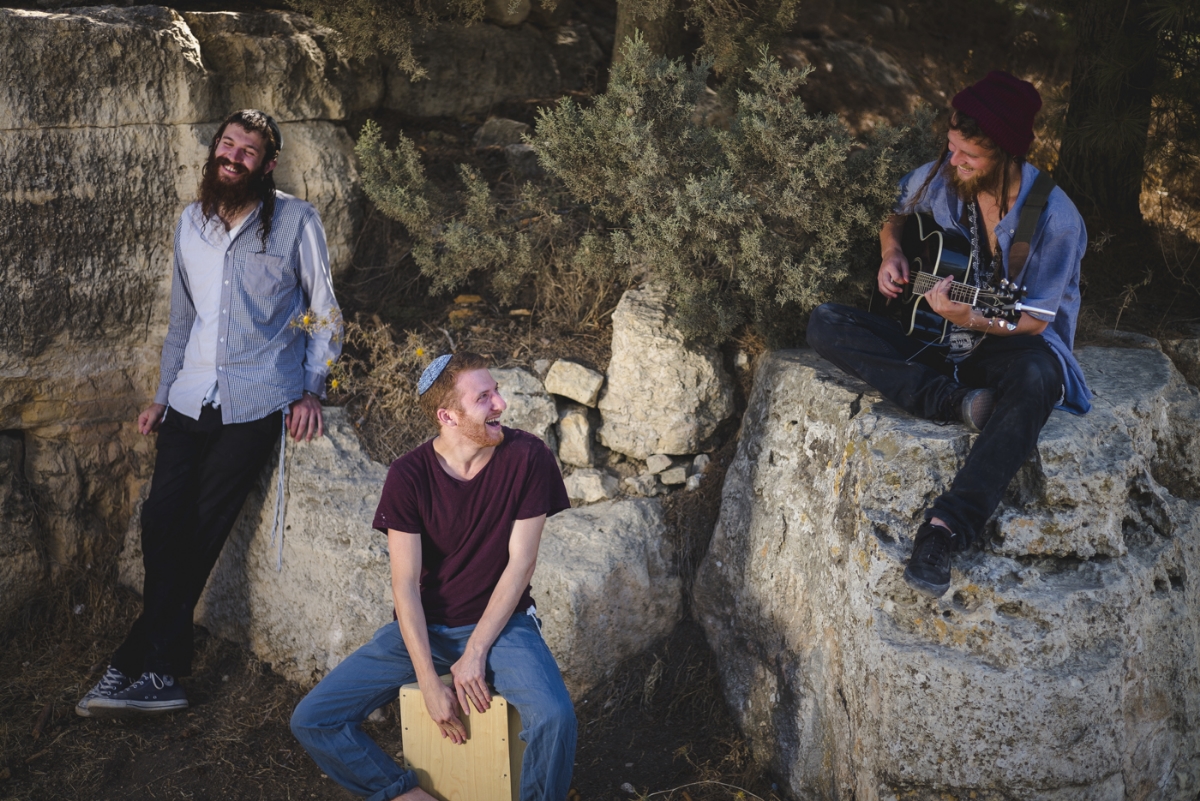
Gaisin (who may be familiar to readers as half of the creative team behind JudaBlue) has demonstrated considerable growth as a vocalist. His soulful crooning has a transcendent effect as the tracks progress from a simple setup into a melodical exploration that almost begs the listener to sway along with the music. Most of the tracks are niggunim, wordless meditations that provide a tapestry upon which the listener can project his own personal meaning. My only real criticism at this point is directed toward the three tracks that have lyrics: while the music/lyrical content are indeed complementary, I always struggle when I hear the same verses/lyrics used time and again (the second track "Peace" uses the oft-repeated expression of Rebbe Nachman Ein yi'ush b'Olam b'chlal as one example). I recognize that the causal link is because there is something significant about those particular expressions, but it can also be indicative of a superficial familiarity with the source material. But I digress - young musicians becoming drawn in to the world of chassidut is a good thing, and I choose to view this as an expression of neophyte excitement.
"Yoel's Niggun" evoked strong feelings that continued long after the initial listen; the best way to describe it is hirhurei Teshuva, making me glad I heard it before Hoshana Rabbah. The final track "Tzion" is a personal favorite; the a capella version below is only a taste a what it is.
One last comment: the band's bio describes them as neo-Chassidic, which is more often a term used to describe groups in the Renewal movement and other groups outside of Orthodoxy. Association is a strong thing, and I don't identify with the need to distinguish myself as a neo-Chassid. Just an observation.
Overall, the debut EP is a strong offering, and I'm looking forward to see what the group does after their tour following the release.
Wednesday, January 15, 2014
Sponsorship opportunity for Breslov works by Rabbi Aryeh Kaplan
Today is the yahrtzeit of Rabbi Aryeh Kaplan OBM. Reb Aryeh's many writings had a profound influence on my life, especially during some of the darker periods of my adolescent years. Both his original works as well as his adaptations and translation helped me see that there is a Judaism that is full of joy and depth, a Judaism that is not necessarily readily apparent.

I received this message in my inbox today:
The Breslov community is particularly indebted to Rabbi Aryeh Kaplan. Rabbi Aryeh Kaplan's translation of "Rebbe Nachman's Wisdom" was first published in 1973 on the initiative of Rabbi Zvi Aryeh Rosenfeld, who was the leading English-speaking Breslover teacher in the United States. It was a pioneering work, being the first reliable translation into English of any of Rebbe Nachman's writings. It required not only a profound understanding of the subject matter itself, but also a unique approach in giving expression to such lofty ideals in a manner which would be both accurate and at the same time accessible to the general reader. This was Rabbi Kaplan's first ever book and he would go on to thank Rebbe Nachman for showing him that he was a gifted and capable writer.It was the publication of Rebbe Nachman's Wisdom that opened the way for the translation of other Breslover works. Subsequently the Breslov Research Institute was founded to undertake the translation and publication of Rebbe Nachman's writings. Reb Chaim Kramer spoke with Rabbi Kaplan about starting the work on several projects, the first was "Outpouring of the Soul," the second was "Rabbi Nachman's Stories." The idea then was to translate and publish the ten major works of the Rebbe, excluding the Likutey Moharan which was considered too difficult to bring down to a layman's level. So they began.Rabbi Nachman's Stories was released in January 1983. Sadly, Rabbi Kaplan passed away right around then, he left over a manuscript of the Rebbe's life which he gave to the Breslov Research Institute and it was named, "Until The Mashiach", published in 1984.Rabbi Kaplan's writes in the preface of his first book, "Spending these months immersed in Rebbe Nachman's works has been a source of inspiration that was, as Reb Noson would say, “beyond the power of words to describe.” It is my hope that they serve as a similar source of inspiration to those who read this book."May the many he inspired bring his holy soul much merit for all eternity, Amen.
 In honor of Rabbi Kaplan's memory, we would like to publish an updated edition of Rabbi Nachman's Wisdom which has been newly edited and typeset and will include updated cover art. If you are interested in sponsoring this project in honor of him and others, please contact us. The cost is $5,000. |
Friday, August 9, 2013
Rebbe Shlomo: Rav Kook on Ishbitz and Breslov Chassidus
Today is Rav Kook's yahrtzeit, the third of Elul. Readers of the blog will remember that my third son's bris was on this day as well!
Z'chuso yagein aleinu!
Tuesday, July 2, 2013
Recovery
I don't remember hitting the ground; the last thing I remember is the ground rushing up at me, and then nothing.
I can feel the aftereffect of the impact, though. As I pick up my head from the dirt, it all comes rushing over me in a cavalcade of pain. It's like someone crumpled my whole body up like a beer can and then kicked it to the curb.
The smell of topsoil fills my nostrils. My vision is blurry and microscopic granules of grit seem to have covered my teeth in a fine patina of grime.
I need to get up. Now.
I place my skinned palms flat on the ground, trying to ignore their abrasive burn and lift myself up, but I am so, so tired.
I need to keep going. Get up!
The back of my neck prickles as I sense It loom over me, watching, waiting, savoring the moment.
My arms strain, and every fiber of my body screams as I make a half-hearted attempt to pull myself off the ground. If I don't get up now, it's all over.
I know that. I recognize the terrible danger I am in now.
The horrible laugh fills my ears. Get up!
But now that I'm down here, it makes so much sense to just rest...if only for a minute...
It would be so much easier if I could just lay my head back down, close my eyes and slip into a deep sleep...
Rebbe Noson said that more than the actual sin itself, the Evil Inclination waits for the depression that follows it.
It hurts and it's crazy hard, but you must get back up again.
Your life depends on it.
Literally.
I can feel the aftereffect of the impact, though. As I pick up my head from the dirt, it all comes rushing over me in a cavalcade of pain. It's like someone crumpled my whole body up like a beer can and then kicked it to the curb.
The smell of topsoil fills my nostrils. My vision is blurry and microscopic granules of grit seem to have covered my teeth in a fine patina of grime.
I need to get up. Now.
I place my skinned palms flat on the ground, trying to ignore their abrasive burn and lift myself up, but I am so, so tired.
I need to keep going. Get up!
The back of my neck prickles as I sense It loom over me, watching, waiting, savoring the moment.
My arms strain, and every fiber of my body screams as I make a half-hearted attempt to pull myself off the ground. If I don't get up now, it's all over.
I know that. I recognize the terrible danger I am in now.
The horrible laugh fills my ears. Get up!
It would be so much easier if I could just lay my head back down, close my eyes and slip into a deep sleep...
Rebbe Noson said that more than the actual sin itself, the Evil Inclination waits for the depression that follows it.
It hurts and it's crazy hard, but you must get back up again.
Your life depends on it.
Literally.
Thursday, June 20, 2013
Rolling with the resistance
When people want to become truly religious and serve God, they seem to be overwhelmed with confusion and frustrations. They find great barriers in their path and cannot decide what to do. The more they want to serve God, the more difficulty they encounter.
All the enthusiasm that such people have when trying to do good is very precious, even if their goal is not achieved. All their effort is counted like a sacrifice, in the category of "For Your sake, we are killed each day, we are counted like sheep for slaughter." (Psalms 44:23) The Tikkunei Zohar states that this verse speaks of both prayer and sacrifice.
When a person wants to pray, he encounters many distractions. But still, he gives himself over entirely to the task, exerting every effort to pray properly. Even if his prayer is not perfect, his very effort is like bringing a sacrifice, in the category of [the above verse]. The same is true for everything else in religion. You may wish to perfect yourself, but find yourself unable to do so completely. Still, the effort and suffering involved in the frustrated attempt are not in vain...
Therefore, always do your part, making every effort to serve God to the best of your ability. Whatever task lies in your hand do it with all your might (Kohelet 9:10). Keep it up, even when all your efforts seem to be frustrated and all your attempts in vain. Do everything in your ability, and God will do what is good in His eyes (I Shmuel 3:18) - Sichot HaRan, 12*What chizuk! Just as I was setting out on an endeavor to bolster certain elements of avodah that needed a boost, I encountered the above passage while waiting during minyan.
Caution: some coarse language which has been poorly *bleeped* out.
* English translation adapted from Rabbi Nachman's Wisdom, by Rabbi Aryeh Kaplan (B.R.I.)
Sunday, May 5, 2013
Music
I just got the two newest albums from The Heart and the Wellspring ensemble. One is comprised of Chabad niggunim, the other of niggunim from Rav Yitzchak Ginsburg of Gal Einai.
HaMadregot also released a new album recently, one consisting of pizmonim from Rabbi Avraham Ibn Ezra, one of the foremost commentaries on the Torah and an incredibly complex poet.
Awesome!
Thursday, March 7, 2013
Rav Weinberger on Rebbe Nachman
The Breslov Research Institute recently celebrated the completion of rendering the Likutei MoHaRan into English with a gala siyum in Queens. Rav Moshe Weinberger was one of the speakers (although this is not that speech) at the event, along with Elie Weisel (who can also be seen on BRI's vimeo page -[it wasn't embed-able. sorry]). Watch Rav Weinberger below!
Wednesday, February 15, 2012
Jewish Meditation: A Practical Guide by Rabbi Aryeh Kaplan
This is awesome. One of my favorite books ever, available for free online.
HT to RYGB.
Aryeh Kaplan - Jewish Meditation, a Practical Guide
HT to RYGB.
Aryeh Kaplan - Jewish Meditation, a Practical Guide
Thursday, December 22, 2011
Awesome sale!
The website for Rav Moshe Weinberger's shiurim is holding a MAJOR sale until Sunday. All Chanukah related shiurim are 25% off, and all shiurim in chassidus are 32% off!
 Rabbi Weinberger has given thousands of shiurim on a broad variety of topics and sefarim. Now you can get shiurim on the Avnei Nezer, Be'er Mayim Chaim, the B'nei Yisaschar and much much more for a significantly reduced price.
Every penny is worth it, believe me.
Every penny is worth it, believe me.
Tuesday, December 13, 2011
An Evening With Rebbe Nachman: Rabbis Chaim Kramer & Moshe Weinberger
Finding this video in my inbox was the high point of the day. I was disappointed that I couldn't make the event, but this tempers that a little.
As posted earlier, the Breslov Research Institute is nearing the completion of its translation of Likutei MoHaRan, a staggering project that spans fifteen volumes with full text and commentary. These projects don't run on their own steam, though; the BRI needs help with funding. Follow this link to see how you can help.
As posted earlier, the Breslov Research Institute is nearing the completion of its translation of Likutei MoHaRan, a staggering project that spans fifteen volumes with full text and commentary. These projects don't run on their own steam, though; the BRI needs help with funding. Follow this link to see how you can help.
Tuesday, November 22, 2011
Awesome fundraiser idea.
An Evening With Rebbe Nachman
The Breslov Research Institute is trying to finish the final volume of their momentous translation of Likutei MoHaRaN. All proceeds of this event is going toward the project, which is a boon to those searching for a lucid text and clear explanation of Rebbe Nachman's Torah.
I would love to go, but it's beyond my budget at this time.
Sunday, November 20, 2011
Catharsis on Paper
A recent paper I wrote for one of my college Psychology courses:
Introduction
Judaism has always been a religion of positive focus, its adherents finding inventive ways to infuse their service with joy, meaning, and fervor. It is taught that through honest, selfless worship of God, one can simultaneously elevate the mundane through divine service as he transcends his physical trappings in spiritual bliss. Perhaps more so than other religions, Judaism takes pains to ensure that humans – not just constituents of the faith – live a life of pleasantness, compassion, and ultimately happiness.
Similarly, Psychology has a focus on health and wellbeing. For a while, the zeitgeist focused on the pathological aspects of the psyche, focusing on abnormalities, mental illness, and other negative characteristics that crop up in the field. However, both the field’s philosophical beginnings as well as its shifting focus of research have been that of helping others achieve healthier lifestyles and mindsets. Indeed, even during that era of psychopathology, it is self evident that the original intent and subsequent efforts of therapy, psychoanalysis, and other innovations were with the goal of returning the patient to an point of origin beyond sickness, on the road to health. As such, the field has grown rich with many interventions, designed to help people cope, adjust, heal and determine the best possible path in life.
The Importance of Language
In both Judaism and Psychology, there is a primacy placed on language. The way we give expression to feelings, thoughts, and emotions, as well as our conceptualization of many different ideas and theories is contingent on the common language that we share. It is as integral a tool for the rabbi sermonizing to his congregation as it is for the therapist establishing a rapport with his client; coreligionists and colleagues alike rely on the jargon of their respective communities, yet strive to find the words to make it accessible for the “outsider” or layman, when necessary. Language allows us to reify the abstract, to clearly delineate and define our magnificent ideas into something coherent and structured.
Ultimately, language bestows us with the power to create; every instance of speech or communication is a creative process that we tap into, usually unaware of the amazing power that we yield. Practically speaking: using language we can build bridges between people, and perhaps more importantly, inroads into our selves.
Most of therapy is predicated on some sort of communication; the same can be said about religious worship. While it often seems as if the dialogue is one-sided, there is an inherent belief in both instances that there is a reciprocal relationship occurring, albeit in a more nuanced fashion. Beyond the dynamics of the sessions themselves, however, is the utilization of the written word as a helpful, effective intervention with various applications.
Writing as a Cognitive, Behavioral Practice
Psychologist Martin Seligman has written extensively about the positive effect of writing exercises. One of his innovations is “gratitude writing”, in which the client makes a list at the end of the day of all of the good things that happened to him or her throughout the day. Seligman stresses that when it comes to these exercises, nothing is too small or insignificant, but rather the person should strive to remember and record each positive occurrence, along with why he or she thinks such a thing happened (e.g. “My wife pressed my shirts the way I like them today.” and “She did this because she is a thoughtful, caring person.”). The effect of this exercise is twofold: it trains one to view the world, and others in a good light. Seligman also exhorts the practitioner to keep a physical record of the list (Seligman, 2011) : the writing itself is of equal importance, due to its role in the habituation of the practice, as well as the creative awareness that writing engenders.
A parallel practice exists in Judaism as well. Hasidic thought – especially that of Rabbi Nachman of Breslov – is preoccupied with focusing on the positive elements of life. The inherent joy that can be found in our existential roles in the physical realm is a main tenet of Hasidic philosophy, and most of the practices associated with Hasidism reflect this sensitivity. Rabbi Nachman in particular battled the human tendency toward depression by preaching the necessity of finding the “good point” (nekuda tova) in every person – most all, the good point within one’s self. That infinitesimal spark of goodness – hidden in even the most depraved, wretched being, mired with the filth of sin – can be found, cultivated, and blown into a raging fire of holy passion that resuscitates the soul of that person. That is the deeper meaning of the verse in Psalms: “I will sing to God with what I have left.” (146:2) To wit: with that small part of what is left of the Godly soul, the sinner rapturously clings to it and returns to God (Sternhartz) .
Utilizing the above teaching, Grand Rabbi Aryeh Wohl of Sudilkov (based in Ramat Beit Shemesh, Israel), a contemporary Hasidic teacher, has designed a similar – yet unique - practice to Seligman’s. Here is an excerpt from a student who received instruction from the Sudilkover rebbe (explanations and translation of terms mine):
The Rebbe then advised me to get a notebook and draw lines down the pages and divide them into three columns. In the first column, I was to record things that I did good [sic] that day; to include even small things like washing negel vasser (ritual hand washing upon arising from sleep) in the morning upon arising. In the second column, I was to record the challenges and nisyonos (Hebrew for “challenge” or “test”) that I experienced that day. This was to include things such as occurrences when I failed to maintain my composure and expressed my anger. Finally, in the third column I was to record examples of Hashem's chasadim (kindnesses) that I observed that day.
The Rebbe instructed to read what I had written down out loud before I said Krias Shema al HaMita each night… (Anonymous, 2007)
The Rebbe instructed to read what I had written down out loud before I said Krias Shema al HaMita each night…
After several weeks of carefully following the instruction of his teacher, the student observes with pleasant surprise:
…Each night my list of good points and the list of chasadim grew longer and longer and my list of challenges/nisyonos grew shorter and shorter. The process of having to be conscious each day to write something down made me stop and think at intervals throughout the day. What am I doing good today? What am I not doing good today? (Anonymous, 2007)
As with Seligman’s intervention, Rabbi Wohl’s methodology helps the practitioner build up a sense of self efficacy, allows the person to place matters in a proper positive perspective, and increases the cognizance of one’s actions in day-to-day dealings. People who engage in these sorts of exercises will seek opportunities to find the good in daily occurrences. They will be more aware of the consequences of their actions when they recognize that they will have to make an accounting at the end of the day. This is in line with the Jewish concept of cheshbon haNefesh (“accounting of the soul”), a similar exercise wherein one keeps extensive, detailed records of nearly every action and thought that he had, with the intention of examining these records at the end of the day to discern the areas of his character refinement that require attention.
Structure Building Exercises
The above ideas can be adapted for nearly anything. Rabbi Kalonymos Kalman Shapira of Piaseczna, a Hasidic Rabbi who lived (and perished) in Poland during the Holocaust, wrote a masterful volume geared toward young students. The book, A Student’s Obligation (Chovat HaTalmidim, Warsaw 1929) is replete with behavioral (as well as cognitive) exercises designed to help the youth overcome such common deficiencies like laziness, poor planning skills, lack of commitment, and inefficient task completion. He too emphasizes the importance of writing things down:
It is beneficial to write out a schedule for yourself on a sheet of paper, starting with the time you wish to get up in the morning and continuing with all your activities. Use the sheet as a reference, checking back during the day to see if you have accomplished what you set out to do. (Shapira, 1995)
While the rebbe's target audience for the book was yeshiva (Rabbinical seminary) age students, and thus he mentions this in the context of learning sessions and finding spare time for extra study sessions, the rebbe clearly saw the value in this technique for people in all walks of life:
Whether you are in yeshiva or not, the schedule of study that you set for yourself should be followed to the minute. You should get to the point that if for some reason you are not able to complete a period of learning, you should feel pained, as if the day itself remained uncompleted....
Each day, make it a practice to check yesterday's schedule. What you did not complete yesterday, you should attempt to complete today. You should only do this, however, if you were unable to finish because of laziness or lack of diligence. If you were thrown off schedule because of a difficult passage...then you should not force yourself to complete [what] you missed yesterday.
The whole idea of keeping to a quantitative schedule is to discipline yourself to learn crisply and without meandering. (Shapira, 1995)
While it is clear that the rebbe's focus was on Torah study, his advice can be applied to the totality of the day. The carefully mapped out day will more often than not yield far better results in accomplishment than the haphazard approach to our busy lives. Moreover, it introduces the concept of discipline into everyday operations, which generates consistency, an important ingredient to a healthy lifestyle. There are varying degrees to the stricture of your structure; some people may prefer an outline as opposed to a minute-to-minute checklist. As with everything, it has to be done with a keen sense of self awareness and intellectual honesty.
This suggestion also lends itself finely to the idea of cheshbon haNefesh, as explained above: at the end of the day, one can refer back to his schedule and see how he did. As he starts to sort through the day's events, determining what held him back here, why he dragged his feet at that point, etc. that will aid him in recalling the particularities of the day, and his interactions with people. This segues perfectly into a real, honest soul-searching, which is Rabbi Shapira’s ultimate intent.
Writing as Therapy
Perhaps one of the most important elements of writing is the therapeutic nature of writing. As Ernest Hemingway once said, “There is nothing to writing – all you do is sit down at a typewriter and bleed.” As we mentioned earlier, the process of writing is no less than a creative act, one in which we conceive an idea and carry it within us until it is ready to emerge into the world. The “birth process” – fleshing out an idea and putting it out into the common reality we share with others is simultaneously painful and exhilarating. By giving voice to our passions, our hopes, even our fears, we proclaim our existence to the world and lend credence to our innermost thoughts by acknowledging them openly. Moreover, the very act of writing may assist in relieving tension by serving as an outlet for strong emotions, the medium serving as a “safe” forum for expression. Those thoughts that are too provocative, frightening, or hurtful to be shared with another person can be let out in a private journal. The writing process is a pressure valve, an opportunity for catharsis that is almost unparalleled.
Returning to Rabbi Shapira for a moment, he offers another daring intervention based on this principle. At the end of the ninth chapter, the rebbe addresses the issue of reconciling with an enemy with whom the mutual hate is so great that you simply cannot find any redeeming qualities in this person:
This is what you should do. Write him a letter. Don't send it to him; hide it somewhere in your home. In the letter, insult and shame him as much as the serpent of anger in your heart desires. For some days, read the letter aloud, and imagine that you are standing in front of him, taunting and abusing him with all the expressions of the letter. After some days, you will find your anger has dissipated, and if you are a sensitive person, you may discover yourself running to reconcile with him. (Shapira, 1995)
More than an act of catharsis, the rebbe's advice shows a profound quality in our nature. After pouring out all the venomous feelings and thoughts about this person into this composition, the student is encouraged to reread it every few days. Despite the fact that in the heat of the moment he was able to pen such hateful, hurtful words, a few days later those words will seem to be alien and foreign, and he will have a hard time believing that we actually wrote them.
With every subsequent reading, the student will observe "Wow, I was being pretty harsh. He's not like that all the time..." and he will begin to see flaws in his hateful view of this person. Moreover, he will begin to find ways to counter the arguments made in the letter, and find redeeming qualities in this fellow as he subsequently revisits the letter. Eventually, the feelings of hate and anger will have been replaced by a powerful desire to reconcile with this person, and like Rabbi Shapira asserts, he will run to make peace with him.
Writing allows one to work through a problem, to record all the different factors swirling around in his thoughts and categorize them, and give him something to work with. When ideas are brought into the practical realm, it makes them more manageable to deal with – and a lot less scary.
Writing as Legacy
Writing serves another important function: the giving others a part of one’s self, preserved for posterity. Writing provides an opportunity to bestow on others an intellectual legacy, his curriculum vitae that can be passed on to subsequent generations of family members, students, and general audiences. Lord Byron wrote: “But words are things, and a small drop of ink, falling like dew upon a thought, produces that which makes thousands, perhaps millions, think.” Giving the world works that inspire creativity, that challenge people to consider (and reconsider) their tightly held notions, that encourages people to imagine something larger than themselves is an important value for many. Writing helps them achieve this goal and reach the greatest amount of people.
Tuesday, November 8, 2011
My Soul Thirsts...
Thirst is a very great desire. The more thirsty you are, the greater your pleasure in drinking water.
The same is true of your holy thirst for God; this is the delight of the World to Come. - Rebbe Nachman, Sichot HaRan 259Rav Moshe Weinberger once related a story that happened when he and his father went on a fishing trip. As they were sitting out in the middle of the lake, it began to rain. His father showed him that the fish swam to the surface, and jumped to catch the raindrops in their mouth.
He explained that indeed, these fish are surrounded by water all the time. But when it comes down straight from the Source, there is nothing that tastes better.

Monday, July 4, 2011
Gimmel Tammuz 5771
I know that I haven't posted in a while - I've been really busy since starting my truncated summer semester. The workload is just staggering!
In any case, the following shiur is really more appropriate for sefirah, but because it features a phenomenal story about the Lubavitcher Rebbe OBM (whose yahrtzeit begins tonight, the third of Tammuz), I felt it fitting to post now. Enjoy!
For more on the Rebbe, see this post that I wrote last year.
Also, take a look at the below video, in which the Rebbe meets a grandson of the author of HaSulam, a commentary on the holy Zohar: I appreciate the Rebbe's reverence for his forebears - it's a lesson we can all learn from. Especially important is his assertion that chassidus is not synonymous with kabbalah, despite the fact that we are exposed to kabbalistic concepts through our study of chassidus. Moreover, his respect for other paths toward Truth is apparent.
Z'chuso yagein aleinu.
In any case, the following shiur is really more appropriate for sefirah, but because it features a phenomenal story about the Lubavitcher Rebbe OBM (whose yahrtzeit begins tonight, the third of Tammuz), I felt it fitting to post now. Enjoy!
|
For more on the Rebbe, see this post that I wrote last year.
Also, take a look at the below video, in which the Rebbe meets a grandson of the author of HaSulam, a commentary on the holy Zohar: I appreciate the Rebbe's reverence for his forebears - it's a lesson we can all learn from. Especially important is his assertion that chassidus is not synonymous with kabbalah, despite the fact that we are exposed to kabbalistic concepts through our study of chassidus. Moreover, his respect for other paths toward Truth is apparent.
Z'chuso yagein aleinu.
Saturday, May 14, 2011
Rav Elazar Kenig in Flatbush tomorrow!
Rav Kenig is the spiritual leader of the Tzfat Breslov community. He is a tremendous talmid chacham and tzaddik.


Thursday, May 5, 2011
New BRI Promo!
Get a FREE Book Sale!
The Breslov Research Institute - the organization headed by Rabbi Chaim Kramer that is primarily responsible for translating and disseminating the Torah of Breslov chassidus to the English speaking world (not to mention several other languages) is having a sale. If you buy their coffee-table edition Breslov Pirkei Avot, you can get a free book.
The BRI is a boon to those who wish to make an entrance into the world of Rebbe Nachman and Breslov thought; their various writers work tirelessly to advocate the study of chassidus and the nurturing of a close and personal relationship with HaShem.
Monday, May 2, 2011
Du, du, du!
I always appreciate it when two seemingly disparate things that I'm involved in come together; we have a tradition that if we come across similar concepts in separate limmudim during one day, there's a certain significance that we must take notice of.
This past Friday night after the seudah (meal), I came across the following:
Despite all my efforts to the contrary, it always seemed like my urges and desires would get the best of me; even those times when I didn't necessarily feel the draw of my ta'avot, I would think about ways of stimulating and arousing those thoughts. Any victories would be short lived and fleeting, overwhelmed in the face of the sheer volume of times when I succumbed to my basest desires. Compounded by the existential struggles and questions that I grappled with in my adolescence, along with the negative experience of my high school years, I actually believed that there was no possible way that God would hear - let alone listen to - my prayers.
(Concerning one specific problem which is common amongst young men, I never felt so alone as when I was in high school. In my naivete, I believed that I was the only one who had this problem, certainly the only one who actually transgressed. This erroneous belief was reinforced by my teachers and peers, who stigmatized this particular sin as being heinous and particularly deviant; only the most evil minded people actually perpetrated this act. One particularly embarrassing moment was when my roommate "confided" in me that he had heard "someone" (I knew that he meant me, of course) in the bathroom, and proceeded to mock "that sicko" for what he had done, forcing me to join him in the lambasting to keep up the deceit.
The first time that I openly admitted it to a trusted friend, and he responded in kind with the reassurance that many of us go through this struggle, and that we must stay strong and help each other was like a weight lifted off of my shoulders; when I transferred to another yeshiva later I found a small group of honest individuals who were interested in reinforcing their shmirat einayim through the focus of a mussar seder with group support. But I digress.)
The teachings of Breslov and Reb Kalonymos Kalman specifically, and chassidus in general is about the omnipresence of God. The paradox of tzimtzum (Constriction) versus the panentheistic belief of God is irreconcilable to our finite intellect, and yet we believe in both. The very idea that there can be a place devoid of God's presence is antithetical to our ability to function as human beings engaged in the struggle for perfection. The knowledge that no matter how bad it gets we are not alone and all we need to do is fight back in earnest is an integral part of the human struggle. "One who comes to purify himself, we assist him."
This is the importance of real prayer, as explained later on in Meshivat Nefesh and other places: no matter where you go, the power of speech accompanies you (Rebbe Nachman explains that speech is the "mother of all children"; the same way a mother will follow her child into even the filthiest of places, so does the faculty of speech). Therefore, one should always engage in prayer and honest conversation with God, and with those whom he feels closest with, gaining mutual support.
*English translation adapted from Sacred Fire: Torah From the Years of Fury by J. Heshy Worch (Aronson)
**English translation adapted from Restore My Soul by Avraham Greenbaum (BRI)
This past Friday night after the seudah (meal), I came across the following:
It is well known that no Jewish person is ever utterly excluded from the totality (II Kings 14:14). When a person comes to a nadir, God forbid, and is about to commit some transgression - especially if this will cause his exclusion, God forbid - then God does not abandon him. We have learned in sacred literature that the miluy of the three Hebrew letters yud-tzadi-reish comprising the word "yetzer" (inclination) are (Y) vav dalid, (TZ) dalid yud, and (R) yud shin. The last letters of the miluy are the three letters of the name of God, Shad-dai (shin-dalid-yud). In order that the person not succumb entirely to his inclination, God forbid, the Holy Name Shad-dai is there at the end. When the person reaches the end, God does not allow him to fall any further. - Reb Kalonymos Kalman Shapira, Aish Kodesh (Kedoshim 1940)*The next morning before shacharis, I found an idea that reflected the same concept:
There are places which are so low that they seem totally divorced from God. Yet it is precisely there that the most exalted life force is concealed: there are the "secrets of the Torah." A person who has fallen far must know that in the very place where he finds himself he can achieve unique closeness to God because of the exalted life force which is concealed in that very place. When such a person turns to God, a very high revelation of Torah comes about: the "Secrets of Torah." - Rebbe Nachman, Likutei MohaRan I:56 (as quoted in Meshivat Nefesh)**The fact that we can find God in any place, no matter how far we seem to be from the Source, is a profound and fundamental teaching of chassidus (other paths of Jewish thought discuss this as well, but more so in chassidus, in my experience) . It is one that gives tremendous chizuk to many, including myself. I remember times when I felt so low, so disgusted with myself and my failings that I nearly despaired.
Despite all my efforts to the contrary, it always seemed like my urges and desires would get the best of me; even those times when I didn't necessarily feel the draw of my ta'avot, I would think about ways of stimulating and arousing those thoughts. Any victories would be short lived and fleeting, overwhelmed in the face of the sheer volume of times when I succumbed to my basest desires. Compounded by the existential struggles and questions that I grappled with in my adolescence, along with the negative experience of my high school years, I actually believed that there was no possible way that God would hear - let alone listen to - my prayers.
(Concerning one specific problem which is common amongst young men, I never felt so alone as when I was in high school. In my naivete, I believed that I was the only one who had this problem, certainly the only one who actually transgressed. This erroneous belief was reinforced by my teachers and peers, who stigmatized this particular sin as being heinous and particularly deviant; only the most evil minded people actually perpetrated this act. One particularly embarrassing moment was when my roommate "confided" in me that he had heard "someone" (I knew that he meant me, of course) in the bathroom, and proceeded to mock "that sicko" for what he had done, forcing me to join him in the lambasting to keep up the deceit.
The first time that I openly admitted it to a trusted friend, and he responded in kind with the reassurance that many of us go through this struggle, and that we must stay strong and help each other was like a weight lifted off of my shoulders; when I transferred to another yeshiva later I found a small group of honest individuals who were interested in reinforcing their shmirat einayim through the focus of a mussar seder with group support. But I digress.)
The teachings of Breslov and Reb Kalonymos Kalman specifically, and chassidus in general is about the omnipresence of God. The paradox of tzimtzum (Constriction) versus the panentheistic belief of God is irreconcilable to our finite intellect, and yet we believe in both. The very idea that there can be a place devoid of God's presence is antithetical to our ability to function as human beings engaged in the struggle for perfection. The knowledge that no matter how bad it gets we are not alone and all we need to do is fight back in earnest is an integral part of the human struggle. "One who comes to purify himself, we assist him."
This is the importance of real prayer, as explained later on in Meshivat Nefesh and other places: no matter where you go, the power of speech accompanies you (Rebbe Nachman explains that speech is the "mother of all children"; the same way a mother will follow her child into even the filthiest of places, so does the faculty of speech). Therefore, one should always engage in prayer and honest conversation with God, and with those whom he feels closest with, gaining mutual support.
*English translation adapted from Sacred Fire: Torah From the Years of Fury by J. Heshy Worch (Aronson)
**English translation adapted from Restore My Soul by Avraham Greenbaum (BRI)
Monday, March 21, 2011
Kabbalah and Jazz: The Mystical Foundation of Improvisational Music
From Rabbi Adam Jacobs, via the Huffington Post:
In his great work To Heal the Soul, Rabbi Kalonymus Kalman Shapira wrote that all humans each have their own unique musical ladder -- a distinct melody that allows one to draw down spiritual sustenance into this world. This melody is exclusive and in essence can not be performed by anyone else. He believes that it is so individualized that to use someone else's ladder is like putting someone else's saliva into your mouth to sing. This concept is so ubiquitous, so universal, that Rebbe Nachman of Breslov went as far as to say that each and every blade of grass has its own unique melody as well. Very poetic, but is there any substance to it?
Years ago this assertion would have been harder to make but not so since the advent of String Theory. Though there are many who reflexively disparage it, the fact of the matter is that as time progresses, science and mysticism seem to be merging. For instance, since the time of Aristotle, the common wisdom was that matter had always existed. So ingrained was this notion that even Einstein was prepared to "fudge" his own math to uphold the view (a move he would later call "the greatest blunder of my career"). The 3,300-year-old Jewish view that there was a "Beginning" to reality as we know it stood out in sharp relief against the prevailing wisdom and was vindicated in the last century. Science had taken a step toward religion.
As science developed the technological capability to peer deeper and deeper into the essence of matter, the familiar notion of minute balls or dots of matter was formed -- electrons, protons, neutrons and the like. As it turns out, this picture now seems to be inadequate and has been replaced by Super String Theory, a concept that suggests that the tiny matter contained in the proton is actually composed of uber-small strings, the vibrations of which give rise to all of physical reality. So we see that at its core, the universe is created through sound. In that light, Rebbe Nachman's singing grass does not seem quite as quaint, but is actually substantial. String theory also helps to explain why G-d specifically used the medium of speech (as opposed to thought, deed or anything else) to create the world as outlined at the beginning of Genesis. (Interesting side note: String Theory only works based on a model of the universe that contains either 10 or 26 dimensions which happens to be the exact same numbers suggested by the great Kabbalist Rabbi Issac Luria in the 16th Century.)
What does all of this have to do with Jazz? Well, as we have explained, every facet of the universe is currently singing its own unique tune. This highlights the intrinsic need for us to "be ourselves," and indeed, musicians perform at their peak when they are internally consistent. Miles Davis had trouble finding himself early in his career, preferring to incarnate as a second Dizzy Gillespie. Miles finally asked him why he couldn't play like him and Dizzy wisely explained that Miles heard other sounds in his head and that he should play those. The results were stunning. I once heard the great bassist Dave Holland defend the music of Kenny G as "authentic." "You may not relate to it," he said, "but he's being true to himself and you need to applaud that."
In Conscious Community, another classic by Rabbi Shapira, he explains the prophetic connection to music. Jewish tradition records that the prophets of antiquity used music to lull themselves into the prophetic state. There is a wonderful description in the Talmud of King David's meditative practice. He would prop up his stringed instrument by the open window and in the middle of the night as the wind began to blow across the strings he would be awakened by the tune and begin the process of focusing his thoughts. Rabbi Shapira relates that when the musician begins, he is playing the music and after a while, the music begins to play him. Every serious musician knows this to be the case. In fact, this is the reason they are drawn to play to begin with.
When I gave my graduate recital at the New England Conservatory, there was a moment during improvisations on Mahler's 9th that I simply ceased to be in control of what was unfolding. I became an observer of the performance, aware of it but no longer directing it. Melodies and musical ideas that I had previously been incapable of playing flowed from my fingers. It was fantastic, and for those moments I needed nothing else from life. The audience applause came as a shock, and then it was gone. There is something that the music does to the psyche. What is it? What properties does it have that so elevates the heart and mind? In an evolutionary sense, music has no value. The deaf are quite as capable of propagating the species as anyone else. How is it that these ordered tones compel us so?
Jazz, by virtue of its improvisational nature, forces the players to intently focus on the here and now. The musicians are balanced on a tight rope, not knowing precisely where the other side is and needing to depend on each other to get there. This trust and inspirational flow is similar to our relationship to G-d -- the less we are weighed down by the past or fretting over the future, the more of that natural creative (and spiritual) flow we can access. Many of the players I've spoken to and played with acknowledge this dynamic. They know that they have become a vessel for something bigger. It's their version of a religious rite, though they might never give it that appellation.
Kaballah explains that there are five spiritual dimensions and that at the intersection of the highest two, four energies merge: Eden, souls, Torah and music. This implies that each one of these concepts is a doorway to the others. Though Goethe wrote that architecture was "petrified music," dance, sculpture, drawing et al are not mentioned. It seems as though music hits a plane of reality that is simply higher than other artistic endeavors. It is the language of reality itself and its building blocks. Musicians also know the feeling of deep connection to the other players. It might not last five minutes after they leave the stage, but there is something magical while it lasts. As all people possess souls and as the root of all souls emanates from the top of that fourth world, it would follow that music is also a doorway to the merging of people on a soul level. Pleasure, wisdom, unity and transcendence are all byproducts of the true musical experience.
Saturday, March 5, 2011
Entering Into Adar
This is a shiur that Rav Moshe Weinberger gave several years ago at Derech HaMelech, a wonderful yeshiva in Jerusalem.
Rav Weinberger discusses the importance of prayer, and Amalek's main strategy in trying to destroy us. As always, it's worth listening to.
|
Rav Weinberger discusses the importance of prayer, and Amalek's main strategy in trying to destroy us. As always, it's worth listening to.
Subscribe to:
Posts (Atom)


