Showing posts with label Shabbos Kodesh. Show all posts

Thursday, May 1, 2014

Nesivos Shalom - Erev Shabbos: The Sweetness of Longing

Courtesy of Rabbi Yitzchok Adlerstein

It’s not icing on the cake. It’s halachah.

The emotional component in readying ourselves for Shabbos is fixed in the literature of halachah. Rambam writes[2] “Our Sages command a person…to envelop himself in his talis, and sit solemnly, waiting to receive the presence of Shabbos as if he were going out to receive the king.”

In the hours immediately before Shabbos, both the various Worlds and the souls of the departed move to higher places. How are we to relate to such a time?

The Gemara provides us with an important start at an answer. We find [3] two approaches. R. Chanina would say, “Let us go out to greet the queen- bride.” R. Yanai, on the other hand, would say, “Come, oh kallah; come oh kallah.”

Shabbos is the kallah, explains the Maharsha, citing a medrash, because all the days of the week had “mates,” as the six days of Creation easily form three such “couples.” Shabbos gave the week an odd number of days. To restore harmony, Shabbos needed a partner, and found one in the Jewish people.

We experience the fullness of this marriage on Shabbos itself, which is like nisuin. We instantly comprehend that the avodah of erev Shabbos, then, is kiddushin. Shabbos, continues the Maharsha, is the bride. She is also a queen, in that Bnei Yisrael all become like royalty.

A groom ordinarily goes out to greet the kallah, arriving to ready herself for the wedding. So did R. Chanina, walking out to greet Shabbos. At the wedding itself, the chasan, ready to formalize the entrance of the kallah into the new life they will build, stands under the chupah,and bids the kallah approach. The entrance of the kallah into the symbolic house of the chupah will be followed a short time later with the groom’s bidding her enter their actual domicile. R. Yanai took up this role, in his doubled “come, oh kallah.”

Rabbenu Chananel adds a nuance to the Gemara’s description of R. Chanina. The Gemara offers that description in the context of a legal discussion, one that limits liability of people rushing about on erev Shabbos. When they inadvertently damage others, halachah frees them from the obligation to make restitution, arguing that “they rush about with legal approval.” The Gemara points to R. Chanina as the source of this legal approval. Rabbenu Chananel paraphrases the Gemara, and speaks of him as “dancing onwards, proclaiming ‘come, ohkallah.’” While we don’t see the dancing in the words of the Gemara, Rabbenu Chananel did. He understood that the rushing about sanctioned by Chazal is not born of the pragmatic considerations of getting much done in a short period of time Friday afternoon. Rather, it is made of the same stuff as R. Chanina’s Shabbos-greeting ceremony: emotionally charged, unbridled enthusiasm for the approach of Shabbos, akin to the emotive release of dance. It was the heart that dictated R. Chanina’s behavior, not his wristwatch ticking off the little time remaining before shkiah.

The customary recitation of Shir Ha-Shirim is perhaps the clearest expression of the air of expectancy surrounding erev Shabbos. Elsewhere, the loving relationship between Klal Yisrael and HKBH is framed in terms of the parent-child relationship. “Banim atem” [4]– your are children to Hashem. Shir Ha-Shirim takes the love to the next level – that of a couple, both smitten with lovesickness. It is reminiscent of Rambam’s definition of the proper way to love Hashem: “One should love Hashem with a very great love, so that his soul should be bound up to His love…as if afflicted by lovesickness…All of Shir Ha-Shirim is a mashal to this state.”

More specifically, the recitation of Shir Ha-Shirim sharply defines the key difference between how we experience erev Shabbos relative to Shabbos itself. If Shabbos is a time of intense devekus to Hashem, then erev Shabbos is the time that we are consumed with longing for that devekus. (This is part of the intent of the verse [5] “And they will prepare what they bring.” We arrive at Shabbos’ devekus to Hashem only by preparing ourselves, by anticipating the imminent connection to Hashem through intense longing.) Within the orbit of love-related feelings, it is longing that most characterizes the mood of Shir Ha-Shirim.

The Ohr Ha-Chaim [6] offered a beautiful mashal for this thought. A king divorced his queen. As far as all in the realm were concerned, the divorce was final. He would not have distanced her unless he had completely lost all feeling for her. Their son, however, suspected otherwise. Speaking to his father, he determined that the king still had much love for the ex-queen. When he spoke to his mother, he detected the same feelings of love for her former spouse. To remedy the situation, he composed two songs or verses. One expressed the love of the king for the queen, and the second her love for the king. He sent each song to its proper recipient, and restored the closeness between them. This is why, explained the Ohr Ha-Chaim, the work is called Shlomo’s Shir Ha-Shirim, and not simply Shlomo’s shir. It is literally a song of songs, a song that merges two songs – one of the King and the other or His queen. Between the two versions, we understand the bond between Hashem and His people.

R. Elimelech of Lizhinsk famously stated that were it not for the sweetness of Shabbos itself, he would not be able to contain within himself the sweetness of erev Shabbos. Our approach makes sense of this. Shabbos and erev Shabbos each bring us to a different emotional place. The longing and desire of erev Shabbos disappear when Shabbos arrive, because we then achieve the object of our desire, as the longing gives way to devekus! Each experience is sweet in its own way – and potentially overpowering. R. Elimelech meant that he would be overcome by the strength of the erev Shabbos feeling if it did not come to an end by morphing into the very different feeling of Shabbos itself.

We should mention yet one more aspect of the pre-Shabbos longing. The Ohr Ha-Chaim [7] sees a connection between the word veshamru and a similar expression of “And his father shamar - kept the matter in mind.”[8] Part of our attitude towards Shabbos should be keeping it in mind at all times. We should look forward to it at all times during the week, impressing upon ourselves that all our other activity pales in comparison to the elevated state that we experience on Shabbos. A Jew should spend his entire week with Shabbos!

We are instructed in the Aseres Ha-Dibros to “remember the Shabbos day.” [9] The commentaries tell us that this means that we should mention it all through the week.[10] According to our thinking, however, it may mean more than that. We should live our lives suffused with Shabbos, making Shabbos the central and most important experience of our week.

We relate to the land of Israel in a similar manner. The Gemara[11] [says, “Both he who is born there, and he who longs to see it.” Here, too, the longing and desire are part of the mitzvah.
Through our loving anticipation of Shabbos, we make it the central pillar of our week. By doing so, we draw from the ohr of Shabbos, allowing it to enter all facets of our lives.

[1] Based on Nesivos Shalom v.2 pgs 40-43
[2] Shabbos 30:2
[3] Bava Kamma 32A
[4] Devarim 14:1
[5] Shemos 16:5
[6] In his Rishon Le-Tziyon on Shir Ha-Shirim
[7] Shemos 31:16
[8] Bereishis 37:11
[9] Shemos 20:8
[10]See Ramban, ibid., that we should count the days of the week towards Shabbos
[11]Kesubos 75A


Friday, August 2, 2013

"A day that is entirely Shabbos..."

Tikkun Olam challah cover by Sharon Coleman


Kuntress Kedushat Shabbos: Reb Tzadok HaKohen on man's role in Tikkun Olam, here.

Friday, July 19, 2013

Internalizing Shabbos

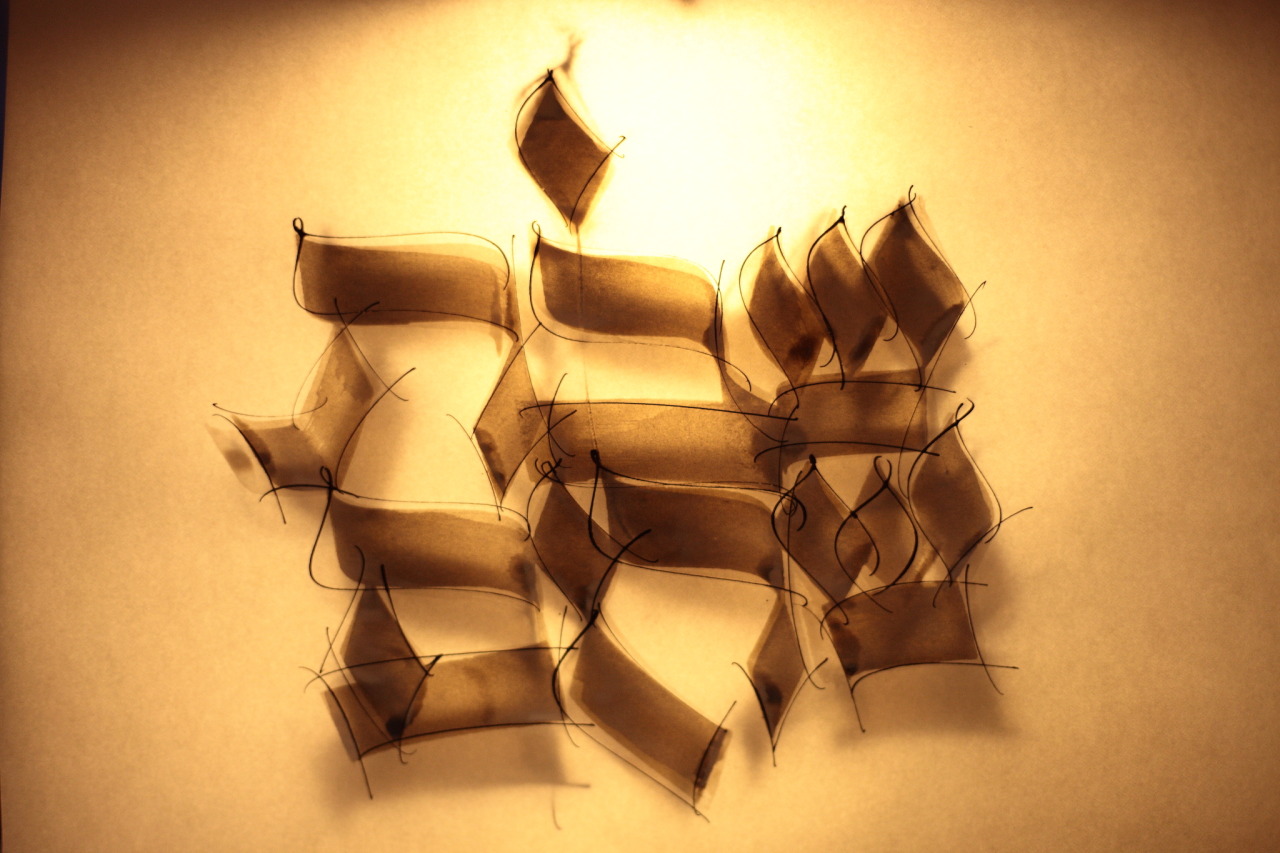
Calligraphy by Michel D'anastasio
“You can keep every Shabbos to the letter of the law, but unless Shabbos reaches the deepest and highest place in your heart, you haven’t kept Shabbos.” - Rebbe Shlomo


Friday, July 5, 2013

Shabbos meditations...

By Rebbetzin Denah Weinberg, from Aish.com:
Look around. The world is a dark place. People are wandering, roaming the world, searching for meaning. They are trying out this philosophy, that religion. People are groping. Where are the answers? Where is the light?
Light was created on the first day, and the Torah says, "It was good."
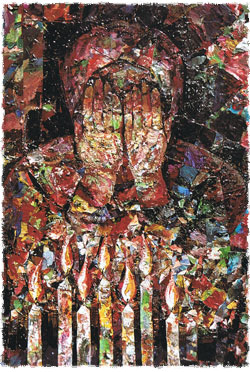
It is a woman's mitzvah to light the Shabbat candles. It is a woman's privilege to bring "good" into the world through light. How can those two little flickering candles on my table, light up the big, dark world?
The Shabbat candles usher in the holy day of Shabbat. Thus those little candle lights direct us to a much greater light, the light of Shabbat.
SHABBAT IS A BIG, BIG LIGHT
The light at the end of the tunnel is bright -- it breaks the darkness. Shabbat also breaks the darkness. It is not just a day when we stop working. Shabbat is the Day of the Candles, the Day of Light, the day when we clearly see our purpose in this world. Shabbat is the day on which we see we have a soul.
The soul itself is called a candle -- the candle of God. It is the light of the world. It infuses spirituality into the body and into all materialism. Without this spirituality, the world would be in a state of darkness. It is the soul that connects human beings to God. Similarly, Shabbat is the soul of the week. Without Shabbat, the world is a body without a soul. When women light candles, we welcome that extra light into the world.
Do you know that Shabbat also gives us an extra soul? During the rest of the week, one soul is powerful enough to receive the available holiness. But we need two souls to handle all the extra holiness that enters the world on Shabbat.
It is all too easy to ignore the extra soul and the extra spirituality that is available every Shabbat, and to spend the day just eating and sleeping. We need to ask ourselves, Is this the most efficient use of an extra soul?
I once heard it said that it's much easier to overcome internal conflicts on Shabbat than all week, because during the week the odds are one against one -- one body versus one soul. But on Shabbat, it is two against one -- two souls versus one body. On Shabbat we have a real chance to be more in control.
LIGHT UP THE SOUL
Candles are lit at romantic dinners, aren't they? What makes a dimly lit room romantic? It's the candles -- they draw people together on a soul level. It goes beyond eating a meal together -- that's mundane, that's physical. Rather, its about two humans connecting on a deep, spiritual level. That's exciting. That's romantic! The candles do it.
This, too, is Shabbat. The candles draw us to each other, and they draw us to God. Our soul is drawn to Him and vice versa. Shabbat is a love song. It is romance. It is a date between God and us. (Remember, on Shabbat, don't concentrate on your food -- concentrate on your date!)
We women are the ones who ignite this romance with God. This is what Shabbat candle lighting is all about.
So let's give our mitzvah some thought and put it into its proper spiritual dimension. Do you feel the light on Shabbat? Do you feel your soul light up?
Our tradition gives us guidelines to experience the spiritual dimension of candle lighting. Buy beautiful candlesticks; make sure they and the tray they rest on are polished to emphasize the importance of this mitzvah. Lighting with olive oil is highly regarded because of the intense light it produces. Be dressed in beautiful clothes at candle lighting time and, of course, be on time (18 minutes before sunset on Friday afternoon). Prepare, think, and be focused on this great experience.
SOUL CONNECTION
Our tradition also tells us something remarkable. To help her children fulfill their potential, a woman should feel tremendous happiness when lighting her Shabbat candles. What won't parents do to have good children? They pay high tuition for the best schools; give them extracurricular activities, hobbies, and vacations to stimulate their minds and strengthen their bodies; feed them good, healthy meals; and buy them fine clothes. Yet Jewish sources tell us that one of the most important things we can do for our children is to be careful and happy when lighting Shabbat candles. This is our investment for meriting good, wise, and spiritually fulfilled Jewish children.
Shabbat candles also create peace in the home. How? People enjoy the Shabbat food more with the added light. And there is something deeper. Candles connect people on a spiritual level. Souls don't fight. Bodies fight. Candlelight evokes a soul connection between people, which creates real peace in the home.
Shabbat reminds us that there was a creation and a Creator. Just as Shabbat comes after six days of work, our ultimate connection to God comes in the World to Come -- after years and years of work! This is clarity. This brings sanity.
Human beings ask, What are we living for? The light of Shabbat answers, For an eternity of light, warmth, and closeness to our loving God.
Shabbat is the goal of the week, not merely a rest stop to prepare for the coming week. In truth, we work all week long for this day of pleasure. There is even a tradition to count the days in anticipation of Shabbat. "We're getting there... We're almost there... We're here!" It's like a bride counting the days to her wedding -- not because the wedding will mark the end of her preparations, but because it is the goal.
Shabbat is our goal, our destination. On Shabbat, all difficulties of the previous week change into a new reality. On Shabbat, all pain changes into beautiful, new challenges.
May we light the candles joyfully, carefully, and happily until the world is lit completely with the lights of Shabbat.

Friday, June 28, 2013

A Meditation for Shabbos

Art by Brooke Sendele
Sabbath Harmony 
We live out our lives in two realms. There is our inner world — our ideals and moral principles, our aspirations and spiritual goals. And there is our outer world — our actions in the 'real' world, our struggles to eke out a living and tend to our physical needs in a challenging and competitive world. The greater the dissonance between our inner and outer lives, between our elevated ideals and our day-to-day actions, the further we will have strayed from our Divine image and true inner self. 
Shabbat, however, provides an opportunity to attain a degree of harmony between our inner and outer lives. 
The holiness and tranquility of Shabbat help enrich our inner lives. Shabbat is a state that is very different from our workday lives, which have been complicated and even compromised by life's myriad calculations and moral struggles. "God made man straight, but they sought many intrigues" (Ecc. 7:29). 
The Sabbath, with its elevated holiness, comes to restore the purity of inner life that was suppressed and eroded by the corrupting influences of day-to-day life, influences that often contradict our true values and goals. But the power of Sabbath peace is even greater. Not only does Shabbat restore our inner world, but it reaches out to our outer world. The spiritual rest of Shabbat enables our outer life to be in harmony with our inner life, bestowing it a spirit of peace and holiness, joy and grace.
Adapted from the writings of Rav Kook in Olat Rayah and Ein Ayah, by Reb Chanan Morrison

Sunday, February 24, 2013

For this did they call these days "Purim," after the pur... (Esther 9:26)
It's worthwhile to consider why Purim is called Purim; all of the other holidays are named for their associated miracle. Pesach is named after the event in which God passed over the houses of the B'nei Yisrael, Shavuot due to the revelation at Sinai, etc. Why then is Purim named after the dreaded plot that the wicked Haman attempted to carry out?

The AR"I HaKadosh writes that the months of the Jewish calendar correspond to different parts of the human head. The month of Tishrei is the cranium, Cheshvan and Kislev are the two ears, and Tevet and Shevat are the two eyes.

The month of Adar corresponds to the nose, the appendage that is associated with the sense of smell.

As we mentioned earlier, all of the senses were implicated in the original sin of Adam, and consequently blemished by that sin. The only exception was the nose, which is why until this day the sense of smell is entirely spiritual (i.e. the soul and not the body derives benefit from it), and in fact will be the means for Moshiach to root out the evil from the righteous.

Now, we know that Haman the descendant of the wicked Agag of Amalek drew his strength from the primordial serpent who enticed Adam and Eve to sin by eating and enjoying the fruit of the Tree of Knowledge. In fact, we see that Haman himself sought to cause the Jews to sin in a similar manner by attending the massive celebrations in Achashverosh's palace where all sorts of food, drink, and diversions were available. His very intention was to evoke the Original Sin and bring about the Jews' destruction in the same way that the original sin caused that all of Mankind became mortal, starting with Adam himself.

It is at this point we see the wonders that the Creator effected!

That Haman cast lots to determine which month would be most fortuitous to carry out his plot and landed on Adar was in fact the turning point! Adar, which corresponds to the nose, the organ that enables the sense of smell, the only sense that was not blemished by that Original Sin that Haman tried to recall and repeat; this is why it is called Purim because Haman's lottery proved to be fortuitous for us, not him! The sense of smell that is completely spiritual - that is called a ko'ach niskayemet - as represented by the month of Adar remains unblemished still, and protected the Jews again from annihilation.

This sense of smell is a dominant theme in Purim especially: Mordechai's name can be broken down as mara dechai one of the ingredients of the ketoret; Esther's true name Hadassah is a fragrant leaf that is often included in the besamim of Shabbos Kodesh...

There is much to be said about these themes. For much more, see the writings of the B'nei Yissaschar on Chodesh Adar.

Friday, January 18, 2013

The Lubliner Rebbetzin...

L'Kavod Shabbos Kodesh, a most enjoyable story


My favorite part is when the Seer is called up to the Heavenly Court: "We expect trouble from you, Seer...but your rebbetzin?!?"

Awesome.

Friday, December 28, 2012

Friday, November 9, 2012

A matter of Time

An hour-long segment about time. Although it's not a Jewish program, there's a lot of rich material in this show to ponder, especially as we enter into Shabbos Kodesh...


This hour of Radiolab, we try our hand at unlocking the mysteries of time.
Jorge Luis Borges wrote, "Time is the substance from which I am made. Time is a river which carries me along, but I am the river; it is a tiger that devours me, but I am the tiger; it is a fire that consumes me, but I am the fire." And it’s still as close a definition as we have. We stretch and bend time, wrestle with its subjective nature, and wrap our minds around strategies to standardize it...stopping along the way at a 19th-century railroad station in Ohio, a track meet, and a Beethoven concert.


Tuesday, April 10, 2012

Interesting question

Thank God, we have the tremendous merit to be in the Holy Land for Pesach this year. It's always interesting for us as b'nei chutz la'Aretz (or chutznikim, as we are colloquially referred to by everybody), those who do not reside in the Land, but still maintain the two-day chag while visiting the Holy Land during the holiday seasons. This is even more the case when one is staying with people who are only observing one day of yom tov; the first time we held our second seder my folks couldn't resist taking pictures as we sat around the table and went through the haggadah.

An interesting thought occured to me yesterday: this year, the chutz la'Aretz's last day of Pesach falls out on Shabbos Kodesh, a regular Shabbos for those who live in the Holy Land. While the chutznikim have a special kriyat haTorah in honor of Acharon shel Pesach, Israelis will read Parshat Shmini. For the next few weeks, Eretz Yisrael and the rest of the world will be out of sync in terms of weekly Torah portions, until Chutz la'Aretz reads a double portion (either Tazria-Metzora or Acharei Mot-Kedoshim) one Shabbos.

For a chutznik who returns to the Diaspora before the Shabbos following the holidays, this is not an issue; he will hear Shmini that Shabbos. However, a chutznik who stays an extra week in the Holy Land - over the course of the following Shabbos - runs the risk of missing a sedra, because the Shabbos after the chag they will read the portion beyond the one he has yet to hear (i.e. because they are a week ahead)!

This is my issue this year. God willing, we will be remaining in the Holy Land another whole week until after the Holy Land's Shabbos Tazria.

After asking around and thinking about the issue ourselves, we decided our best course of action would be to visit an Israeli minyan on Shabbos/Acharon shel Pesach to hear the portion of Shmini. Following that, I would continue on to a "chutz minyan" to make sure I fulfill my chutznik duties.

For a chutznik in the Holy Land, this is a fairly straightforward way of circumventing a potential problem. The question is, what does a chutznik (or for that matter, a resident of the Holy Land who was abroad over the course of the chag) who is ascending from the Diaspora the week following the chag do that Shabbos in the Holy Land?

Any ideas?

Tuesday, February 14, 2012

Rav Tzvi Meir on Shovavim, part VIII

Shiurim - Sichos Hischazkus: Shovavim 8 - eSnips

The final sequence. I'm sorry it took nearly the entire period of Shovavim to go through the ma'amar, but thankfully things have been busy.

Thursday, February 9, 2012

A Life Apart

This is a "must watch" documentary that I mentioned a while back in a post about Reb Shlomo Halberstam, the Bobover Rebbe OBM.

The full version is now available on YouTube. Hat tip to Rebbe Clips.

Friday, January 13, 2012

The love of Shabbos Kodesh

Shabbos Kodesh is the greatest outpouring of love into the universe; one of the reasons we do not bring a sin offering on Shabbos is because when there is true love, all sins are forgiven (this does not preclude the necessity for the sinner to confess and repent, of course, but that is beyond the scope of this post).

The B'nei Yissaschar finds an allusion to this all encompassing love in a wonderful gematria: the numerical value of Shabbos (702) is equal to that of the phrase "Ahavah b'chol lev, ahava b'chol nefesh, ahava b'chol meod." (Love with all [one's] heart, love with all [one's] soul, love with all [one's] being/capacity)

Awesome.

On Shabbos we can return our focus to the relationships that matter most to us - with our spouses, children, family, God...and with ourselves.

Monday, January 9, 2012

Encountering Error in Education

This past Shabbos, I had my first run-in with misinformation as a result of education in my own children. As my big boy proudly recited his parsha sheet chapter and verse (which continues to be a trip for me; my friends and I marvel at the fact that *we* are sitting at the head of a Shabbos table, listening to parsha sheets. It's still very new...), he repeated something to me that he was taught that was flat-out wrong. Not incorrect for the sake of age-appropriate learning, which has its place, but rather a common mistake in pshat. To the best of my knowledge, there isn't even an opinion that learns the text the way his teacher gave it over...

I didn't want to contradict his teacher to him, because I realize that it will cause confusion and undermine the teacher. But when I shared this observation with my wife, she wasn't even aware of the mistake. Why? - because she had always been taught the same exact thing since she was a child!

My question is this: when we encounter such problems, what is the best way to deal with them? Do we "let it go"? If that's the case, until what age? Where do our obligations lie?

Tuesday, December 27, 2011

Idle hands...

Be extremely careful not to waste even a moment. You should view even ten minutes of wasted time as a grave sin (Heaven preserve us). You pay for wasted time with your life. The time that you have thrown away, a part of your life, is gone forever; you will never regain it. Remind yourself of your mortality. This day and time are fading away, and you cannot bring them back. 
If you have wasted time, imagine that you have cut out a strip of your heart and thrown it to the dogs. - Reb Kalonymos Kalman Shapira, B'nei Machshava Tova
This excerpt sent chills up my spine as I read it between aliyot this past Shabbos. Thankfully my busy schedule doesn't necessarily afford me any considerable free time, but in those few moments where there is a lull in activity, I know that I don't always capitalize on that time properly. When the rebbe puts it in such a perspective, this whole matter becomes an issue of v'nishmartam!
As the rebbe stresses numerous times in this sefer as well as in his other writings, boredom and sitting idle is anathema to Judaism...

Thursday, December 22, 2011

Awesome sale!

The website for Rav Moshe Weinberger's shiurim is holding a MAJOR sale until Sunday. All Chanukah related shiurim are 25% off, and all shiurim in chassidus are 32% off!

Rabbi Weinberger has given thousands of shiurim on a broad variety of topics and sefarim. Now you can get shiurim on the Avnei Nezer, Be'er Mayim Chaim, the B'nei Yisaschar and much much more for a significantly reduced price.

Every penny is worth it, believe me.

Tuesday, December 20, 2011

Slonimer Rebbe on Chanukah

Any mistakes are my own, obviously. I'm still trying to figure out the volume levels, and I am naturally soft spoken, so you may need to turn the volume up. Enjoy, and please give feedback!

Shiurim - Nesivos Shalom: Chanukah 1 - eSnips

Sunday, August 28, 2011

Winds of Change

I think that the coinciding of Shabbos Mevarchim Elul (on the Shabbos preceding the new month, we announce the arrival of the new month, and the exact time of the appearance of the new moon) and the approach of Hurricane Irene is particularly apropos. Anyone who lives in the Tri-State area was very busy on Friday preparing for the storm, stocking up on dry goods, batteries, emergency supplies, and the like. I know that I myself entered into Shabbos with more than a little anxiety, as I considered the responsibility of protecting my family in the event of an emergency, God forbid. I knew that ultimately the One Above would protect us, but I also recognized that I would have to be ready to take action...

Reb Kalonymos Kalman writes (see B'nei Machshava Tova; Hachsharas Avreichim) that any feeling is a key to the inner recesses of a person's soul; even if said feeling is completely related to the mundane, the physical, it can be capitalized upon to allow us into our deeper selves. During davening yesterday, as the prayer leader announced the imminent arrival of the month of Elul - the month that officially kicks off the season of repentance and Judgement - I tried to grasp this feeling of wary dread that Hurricane Irene inspired. I imagined hearing the news about the arrival of the King, and quickly running out to stock up on provisions - the mitzvot a parallel to batteries, Torah and prayer spiritual provisions that would keep my family and I sustained during times of scarcity, God forbid...

I think that whether or not Hurricane Irene inflicts major damage on our region, there are valuable lessons to learn from this occurrence...

Stay safe!

Wednesday, August 3, 2011

Storming the Barricade

You spread a canopy over heaven to cover my Temple;
You concealed Yourself and vanquished my strongmen.
- Rabbi Elazar HaKalir, Kinah 6
In his commentary on the Kinot, Rav Joseph B. Soloveitchik OBM compares the above stich to a similar verse in Megillat Eicha: "You have covered Yourself with a cloud, so that no prayer can pass through." (3:44) The implication of these verses is that God has effectively shut the Jewish Nation out; He has not only enshrouded the physical location of his Presence in an opaque cloud to block the supplication of the Prophet, but has concealed Himself as well, as it were.

Rav Soloveitchik expands upon this idea as the fulfillment of the kabbalistic notion of hester panim (Divine concealment). Hester panim is the signal of a new low for the Jewish people - the Jews have reached a spiritual nadir wherein the Master of the World does not distinguish between the righteous and the wicked (Bava Kamma 60a). Essentially, hester panim is a fate far worse than the destruction of the Beis HaMikdash, as it symbolizes the converse of the Cloud of Glory, and the Cloud that descended upon Mount Sinai during the Divine Revelation. Those Clouds signified that the Presence of HaShem was among us, that we were worthy of the moniker "The Chosen Nation"; the paytan is lamenting the advent of a different sort of "cloud".

However, Rav Shimshon Pincus OBM presented a more positive element to this very theme.

He begins with a "novel" explanation about the nature of a mechitza, by reifying the very purpose of this structure. The common conception is that the mechitza is a barrier, something that is created into order to make a separation between people, to divide them. The truth is actually more sublime: the intent of the mechitza is not to separate, but rather to bring people closer. Halachically speaking, if there is no mechitza then men and women cannot be in the same room during prayer, or kriyat haTorah; with the presence of a mechitza, women are able to participate in the same services as the men. In this sense, the mechitza helps people achieve a closeness to God that is otherwise not possible, by bringing them into the prayer hall together with the congregation.

Similarly, when it seems like God is erecting something that separates us from Him, it is really serving the purpose of bringing us even closer to Him. The Cloud at Sinai was necessary for the Revelation; without it, we would never have been able to honor our rendezvous with our Creator! HaShem's glory is too great for us to bear without something "filtering" the splendor and luminescence.

Hester panim works along similar lines. The fact that God has shrouded himself in an impenetrable barrier of thick cloud is not meant to be a deterrent for our attempts to draw close. It is a sign that we must try harder, and that he wants us to strive to draw ever nearer to Him. Like a father who dresses up in a scary costume to frighten his children, the intended effect is that although the children are indeed scared by the horrid mask, they run into his outstretched arms!

Even in terrible moments of hester panim, in our darkest experiences of suffering and anguish, we must call out to Him in heartfelt prayer. Longing for the salvation, we beg with tearful eyes turned toward that very cloud, for we know that He is just on the other side, listening intently. The Gates of Prayer can sometimes be closed, but the Gates of Tears will never be locked.

Although the cloud seems to be thick, seems to be made of a unnatural density that swallows up sound entirely, it is not. Every prayer has immense power, and carries with it the capacity to break through the barrier, causing the rest of the cloud to dissipate like fog. This is true even in our generation, the Ikvisa d'Meshicha, when we are at our weakest; common sense would dictate that if our great predecessors were unable to bring the Redemption, then what can we possibly do?

Rav Moshe Weinberger likens this to the stronghold of a Kingdom that has successfully rebuffed numerous campaigns to infiltrate its fortress, led by some of the greatest military minds in the world. At one point, a small kingdom gathers its men and prepares to make an attempt on this bastion of security. Scoffers mock the men of this modest campaign - if the greatest armies could not prevail, then what chance do these civilian warriors have? But the general reassures his troops: according to his calculations, the previous onslaughts have seriously weakened the barricade of the fortress. With just one more strategic push, they can break through and overtake the city.

Tisha b'Av usually falls out on the week that we read Va'Eschanan, when Moshe relates his attempts to pray for a chance to enter the Holy Land. The commentaries explain that the word Va'Eschanan alludes to the 515 separate, distinct prayers that Moshe offered, pleading for God to allow him entry into Eretz Yisrael. They continue with the note that had Moshe offered just one more prayer, his request would have been granted. We must learn from this a most important lesson about our prayer - we can never know just how much is "enough", so we must always make an effort to pray, consistently and constantly.

HaShem is listening; our prayers can pierce the veil, and bring about the final redemption, so that this 9th of Av can be a real holiday.

Friday, July 8, 2011

"Come in peace..."

An old family favorite:


A special thanks to Eitan Katz who recently released his second "Unplugged" album, essentially a vehicle for getting more "obscure" niggunim from Rebbe Shlomo out to the rest of the world. It's a great album, and I highly recommend it! This song is the first track on the album, a really pleasant surprise.

Have a wonderful  Shabbos!