The truth is, I'm still processing it.
I had the z'chut to attend the annual hilula (celebration) of my Rebbe, Reb Kalonymous Kalman Shapira zya hyd this past motzei Shabbos. It was such an incredibly moving event, the intensity of it all is still so overwhelming that I constantly found my thoughts drifting back to the words that Rav Moshe Weinberger spoke.
This year, the hilula coincided with the debut of a new book that my good friend Binyomin Wolf put out. A collection of the ma'amarim Rav Weinberger gave over the last 15 years since the inception of the hilula in 2000, this slim volume serves not only as an introduction to the Torah of Piaseczna, but that of Rav Weinberger as well. It's a beautiful addition to the legacy of the Rebbe, a strong homage to the message of the Aish Kodesh.
I consider myself fortunate. Lucky to have been introduced the the writings of the Rebbe during a particularly difficult time in my life and then later on - through my efforts to share his work with others - discovering the fount of Torah wisdom that is Rav Weinberger. It's no coincidence that the same praise and gratitude that Rav Weinberger himself attributes to the Piaseczna is said about himself by others. In this year's ma'amar (indeed, the motivation behind the book) Rav Weinberger addressed the phenomenon we are witnessing that people from all walks of life - Jews and non-Jews alike - are drawn to the Torah of the Aish Kodesh in ever growing droves. Soul searchers, academics, meditation enthusiasts, philosophers, people from various streams of Judaism - all come to drink from the wellsprings of Reb Kalonymous Kalman. What is it about the Rebbe? What is the appeal? Rav Weinberger discusses this and more, and it can be listened to here.
For me, personally? As Rav Weinberger intimated, there are people who search for tzaddikim who can breathe life back into our souls. They feel deflated, defeated, lost in the chaos of a world moving at breakneck speed. They long to hear words of encouragement, to taste - briefly - the "dew of life" on their parched lips. They seek healing; some may be healers themselves, giving away their own vitality to others while wondering (doubting!) in the back of their mind whether they have anything to give.
I am such a person.
The Rebbe's writings - in the inimitable words of Rav Soloveitchik - address themselves to the reader's soul. Even if the passage itself is not relevant to my situation, the essence of the Rebbe permeates every word and touches me to my very core. His teaching are a touchstone for me, a guide for my daily living. And many times I don't internalize his words, and I don't feel worthy of considering myself a talmid, let alone a chassid. Still, because of who the Rebbe was, I can never stay far away from him. It is the conviction, the knowledge that the Rebbe is speaking directly to me from the perspective of one who has also suffered that comforts me when I'm confronted with the existential loneliness that we all share.
It's his words of fire and hope that illuminate my darkness, the same words that Rav Weinberger echoed in that darkened room this past motzei Shabbos.
It strengthens me, and I can take hold of myself once more and plunge back into the fray.
Showing posts with label thought/hashkafah. Show all posts
Showing posts with label thought/hashkafah. Show all posts
Thursday, October 22, 2015


Friday, May 29, 2015
Allowing ourselves to be loved

It's a really good point, and I think it does happen. A lot.
But I think a fundamental misunderstanding is at play here (although I'm not attributing this to Karma Dude) that makes the concern all the more real. The concept of a loving God - despite the fact that it's explicit in the texts that we say daily in our prayers - is a foreign one in our community; it simply isn't taught or acknowledged in any meaningful way. Our focus is primarily on our end of the relationship - we must love God, we must serve Him, and service performed out of love is the highest form of avodah. We need to be cognizant of that, ever-aware of our duty to arouse love within ourselves and others for our Father in Heaven in order to succeed in our this-worldly mission. But the other side of that coin is understanding that we are in a reciprocal relationship that starts with God's love toward His creations.
He (Rav Akiva) used to say – Beloved is man, for he was created in G-d's Image; it is indicative of a greater love that it was made known to him that he was created in G-d's image, as it is said: 'For in the image of G-d has He made man' [Bereshis 9:6]. Beloved are the people Israel for they are described as children of the Omnipresent; it is indicative of a greater love that it was made known to them that they are described as children of the Omnipresent, as it is said, 'You are children to Hashem, Your G-d' [Devorim 14:1]. - Avot 3:18When was the last time a rebbi in Yeshiva gave a shmuess that focused on this point? I know many folks who had never heard the words "God loves you," until much later on in life when a mentor or a special teacher revealed that truth to them. I'm under the impression that this is a revelation for many, if at all, and that is very sad. This is something that needs to be articulated, explicitly stated, not assumed to be axiomatic or learned through some osmotic process. What can we do to achieve this paradigm shift?
Thankfully, there are contemporary sources and individuals that belabor this point. The reader is directed to the sifrei Chassidut, some of the latter-day mussar works, and Torah personalities such as Rav Tzvi Meir Zilberberg and the late Slonimer Rebbe. And we must strive to create more English language texts either translated or based on works from Rav Kook and others that deal with this matter extensively. One specific book that comes to mind is GPS! Navigation for the Soul based on the teachings of the Nesivos Shalom which is specifically geared towards teenagers and young adults, but can be read by anybody. The authors spill a great amount of ink making this point in an engaging manner.
And of course, teach your kids. Make it as immutable as anything else in their chinuch - equate it with your own unconditional love, and make it a reality for them.
Thursday, May 21, 2015
Moving Towards God
If you don't understand what's happening, watching a parent teach his child how to walk can seem to be an exercise in cruelty. The child, off balance and teetering around, reaches out for the parent's hand - and the parent steps back, just beyond the child's reach. Of course, the parent is only trying to teach and prepare his beloved child with integral skills in this fashion, and we recognize this process for what it is. The child forgets about the rudimentary movements as his desire to be closer to his father, within his protective embrace temporarily distracts him from this physical task he is trying to master.
The Ba'al Shem Tov used this as a parable for our struggles in life. In those moments when God seems to be pulling away from us, just out of reach, we have to realize that He is teaching us how to walk towards him.
The Ba'al Shem Tov used this as a parable for our struggles in life. In those moments when God seems to be pulling away from us, just out of reach, we have to realize that He is teaching us how to walk towards him.
Tuesday, October 28, 2014
ReBound...
Today is the 4th of Ram Cheshvan, the anniversary of death for the Rebbe of Piaseczna and all the other kedoshim that were part of the liquidation of the Trawniki labor camp.
How is it that every word of your holy writings seems to speak directly to my core, the root of my neshama? No matter what my situation is at the moment I can find relevance in your wisdom.
I, too, want to be a Jew.
Unlike you, I am far from perfect, if not drastically so. So much so that I hesitate to look to you, to bind myself to your teachings and legacy, so as not to sully your reputation and zchuyot by association.
In honor of your yahrtzeit, I wanted to do something different, to separate this day from other days. But even that was a challenge that I struggled to surpass. So instead I decided to serve HaShem with simplicity today. To just pray to Him as I am. To be as real and honest as possible - accepting where I am but not resigned to the position - so that I can look forward, seek beyond the sky and clouds, and get a glimpse of the Throne of Glory and the Almighty King.
And maybe, you'll be sitting there as well, basking in the Divine. And you'll have some nachas from me...
Behold, I attach myself in my prayers, to all the true tzadikim in our generation, as well as to all the holy tzadikim who rest in the earth. -- And specifically, to my holy Rebbe, the Sacred Fire Rav Kalonymous Kalman ben R' Eliezer and Chana Bracha, may his memory shield us, may God avenge his blood.
So what am I missing? Simply to be a Jew. I see myself as a self portrait...Just one thing is missing: the soul.
God! Master of the World, Who sees my innermost secrets! Before You I confess. You I beseech! I feel so cast aside and distanced from You and from Your holy Presence! Help me - I want to become a simple Jew!
God! Save me from wasting the rest of my years and chasing the illusions of life! Draw me closer and bring me into Your innermost Presence! Bind me to You forever and ever in wealth of spirit and soul! - Rav Kalonymous Kalman, Tzav v'ZiruzOh, Rebbe...
How is it that every word of your holy writings seems to speak directly to my core, the root of my neshama? No matter what my situation is at the moment I can find relevance in your wisdom.
I, too, want to be a Jew.
Unlike you, I am far from perfect, if not drastically so. So much so that I hesitate to look to you, to bind myself to your teachings and legacy, so as not to sully your reputation and zchuyot by association.
In honor of your yahrtzeit, I wanted to do something different, to separate this day from other days. But even that was a challenge that I struggled to surpass. So instead I decided to serve HaShem with simplicity today. To just pray to Him as I am. To be as real and honest as possible - accepting where I am but not resigned to the position - so that I can look forward, seek beyond the sky and clouds, and get a glimpse of the Throne of Glory and the Almighty King.
And maybe, you'll be sitting there as well, basking in the Divine. And you'll have some nachas from me...
Behold, I attach myself in my prayers, to all the true tzadikim in our generation, as well as to all the holy tzadikim who rest in the earth. -- And specifically, to my holy Rebbe, the Sacred Fire Rav Kalonymous Kalman ben R' Eliezer and Chana Bracha, may his memory shield us, may God avenge his blood.
Thursday, May 1, 2014
Nesivos Shalom - Erev Shabbos: The Sweetness of Longing
Courtesy of Rabbi Yitzchok Adlerstein
It’s not icing on the cake.
It’s halachah.
The emotional component in
readying ourselves for Shabbos is fixed in the literature of halachah. Rambam writes[2] “Our Sages
command a person…to envelop himself in his talis, and sit solemnly, waiting
to receive the presence of Shabbos as if he were going out to receive the
king.”
In the hours immediately
before Shabbos, both the various Worlds and the souls of the departed move to
higher places. How are we to relate to such a time?
The Gemara provides us with
an important start at an answer. We find [3] two approaches. R. Chanina would
say, “Let us go out to greet the queen- bride.” R. Yanai, on the other hand,
would say, “Come, oh kallah; come oh kallah.”
Shabbos is the kallah, explains the Maharsha,
citing a medrash, because all the days of the week had “mates,” as the six days
of Creation easily form three such “couples.” Shabbos gave the week an odd
number of days. To restore harmony, Shabbos needed a partner, and found one in
the Jewish people.
We experience the fullness
of this marriage on Shabbos itself, which is like nisuin. We instantly comprehend
that the avodah of erev Shabbos, then, is kiddushin. Shabbos, continues the
Maharsha, is the bride. She is also a queen, in that Bnei Yisrael all become
like royalty.
A groom ordinarily goes out
to greet the kallah, arriving to ready herself
for the wedding. So did R. Chanina, walking out to greet Shabbos. At the
wedding itself, the chasan, ready to formalize the
entrance of the kallah into the new life they will
build, stands under the chupah,and bids the kallah approach. The entrance of
the kallah into the symbolic house of the chupah will be followed a short
time later with the groom’s bidding her enter their actual domicile. R. Yanai
took up this role, in his doubled “come, oh kallah.”
Rabbenu Chananel adds a
nuance to the Gemara’s description of R. Chanina. The Gemara offers that
description in the context of a legal discussion, one that limits liability of
people rushing about on erev Shabbos. When they inadvertently
damage others, halachah frees them from the obligation to make restitution,
arguing that “they rush about with legal approval.” The Gemara points to R.
Chanina as the source of this legal approval. Rabbenu Chananel paraphrases the
Gemara, and speaks of him as “dancing onwards, proclaiming ‘come, ohkallah.’” While we don’t see the
dancing in the words of the Gemara, Rabbenu Chananel did. He understood that
the rushing about sanctioned by Chazal is not born of the pragmatic
considerations of getting much done in a short period of time Friday afternoon.
Rather, it is made of the same stuff as R. Chanina’s Shabbos-greeting ceremony:
emotionally charged, unbridled enthusiasm for the approach of Shabbos, akin to
the emotive release of dance. It was the heart that dictated R. Chanina’s
behavior, not his wristwatch ticking off the little time remaining before shkiah.
The customary recitation of
Shir Ha-Shirim is perhaps the clearest expression of the air of expectancy
surrounding erev Shabbos. Elsewhere, the loving
relationship between Klal Yisrael and HKBH is framed in terms of the
parent-child relationship. “Banim atem” [4]– your are children to
Hashem. Shir Ha-Shirim takes the love to the next level – that of a couple,
both smitten with lovesickness. It is reminiscent of Rambam’s definition of the
proper way to love Hashem: “One should love Hashem with a very great love, so
that his soul should be bound up to His love…as if afflicted by
lovesickness…All of Shir Ha-Shirim is a mashal to this state.”
More specifically, the
recitation of Shir Ha-Shirim sharply defines the key difference between how we
experience erev Shabbos relative to Shabbos itself.
If Shabbos is a time of intense devekus to Hashem, then erev
Shabbos is the time that we are consumed with longing for that devekus. (This is part of the intent
of the verse [5] “And they will prepare what they bring.” We arrive at Shabbos’ devekus to Hashem only by preparing
ourselves, by anticipating the imminent connection to Hashem through intense
longing.) Within the orbit of love-related feelings, it is longing that most
characterizes the mood of Shir Ha-Shirim.
The Ohr Ha-Chaim [6]
offered a beautiful mashal for this thought. A king divorced his queen. As far
as all in the realm were concerned, the divorce was final. He would not have
distanced her unless he had completely lost all feeling for her. Their son,
however, suspected otherwise. Speaking to his father, he determined that the
king still had much love for the ex-queen. When he spoke to his mother, he
detected the same feelings of love for her former spouse. To remedy the
situation, he composed two songs or verses. One expressed the love of the king
for the queen, and the second her love for the king. He sent each song to its proper
recipient, and restored the closeness between them. This is why, explained the
Ohr Ha-Chaim, the work is called Shlomo’s Shir Ha-Shirim, and not simply
Shlomo’s shir. It is literally a song of
songs, a song that merges two songs – one of the King and the other or His
queen. Between the two versions, we understand the bond between Hashem and His
people.
R. Elimelech of Lizhinsk
famously stated that were it not for the sweetness of Shabbos itself, he would
not be able to contain within himself the sweetness of erev Shabbos. Our approach makes sense of
this. Shabbos and erev Shabbos each bring us to a
different emotional place. The longing and desire of erev Shabbos disappear when Shabbos
arrive, because we then achieve the object of our desire, as the longing gives
way to devekus! Each experience is sweet in
its own way – and potentially overpowering. R. Elimelech meant that he would be
overcome by the strength of the erev Shabbos feeling if it did not come
to an end by morphing into the very different feeling of Shabbos itself.
We should mention yet one
more aspect of the pre-Shabbos longing. The Ohr Ha-Chaim [7] sees a connection
between the word veshamru and a similar expression of
“And his father shamar - kept the matter in mind.”[8] Part of our attitude
towards Shabbos should be keeping it in mind at all times. We should look
forward to it at all times during the week, impressing upon ourselves that all
our other activity pales in comparison to the elevated state that we experience
on Shabbos. A Jew should spend his entire week with Shabbos!
We are instructed in the Aseres Ha-Dibros to “remember the Shabbos
day.” [9] The commentaries tell us that this means that we should mention it
all through the week.[10] According to our thinking, however, it may mean more
than that. We should live our lives suffused with Shabbos, making Shabbos the
central and most important experience of our week.
We relate to the land of
Israel in a similar manner. The Gemara[11] [says, “Both he who is born there,
and he who longs to see it.” Here, too, the longing and desire are part of the
mitzvah.
[1]
Based on Nesivos Shalom v.2 pgs 40-43
[2] Shabbos 30:2
[3] Bava Kamma 32A
[4] Devarim 14:1
[5] Shemos 16:5
[6] In his Rishon Le-Tziyon on Shir Ha-Shirim
[7] Shemos 31:16
[8] Bereishis 37:11
[9] Shemos 20:8
[10]See Ramban, ibid., that we should count the days of the week towards
Shabbos
[11]Kesubos 75A
[2] Shabbos 30:2
[3] Bava Kamma 32A
[4] Devarim 14:1
[5] Shemos 16:5
[6] In his Rishon Le-Tziyon on Shir Ha-Shirim
[7] Shemos 31:16
[8] Bereishis 37:11
[9] Shemos 20:8
[10]See Ramban, ibid., that we should count the days of the week towards Shabbos
[11]Kesubos 75A
Thursday, February 13, 2014
Fwoosh!
The below stop-motion artwork is by a talented young lady who is one of several students at the Tzohar school in Pittsburgh who are honing and channeling their crafts in ways that enhance awareness and glorify the One Above and His world.
I love this piece.
I love this piece.
Prior to Creation, there was only the infinite Or Ein Sof filling all existence. When it arose in G-d's Will to create worlds and emanate the emanated...He contracted (in Hebrew "tzimtzum") Himself in the point at the center, in the very center of His light. He restricted that light, distancing it to the sides surrounding the central point, so that there remained a void, a hollow empty space, away from the central point... After this tzimtzum... He drew down from the Or Ein Sof a single straight line [of light] from His light surrounding [the void] from above to below [into the void], and it chained down descending into that void.... In the space of that void He emanated, created, formed and made all the worlds. (Etz Chaim, Arizal, Heichal A"K, anaf 2)
Wednesday, January 15, 2014
Repost: Yearning (2010)
I honor of Tu b'Shvat, I'm reposting this story I heard from Rav Moshe Weinberger way back when the Orot HaTorah shiur from Rav Kook was just beginning. It's apropos for the occasion, especially because Rav Weinberger mentioned the story in his massive gathering last week in the Holy Land with several hundred folks who are looking for some fire in the cold, cold winter...
Monday, November 18, 2013
I'm a fan of Rabbi Jonathan Sacks.
I want to be very clear about that before anything else, because what I have to say is critical (in the vein of v'Ani hakatan) of some of his more recent published material in the form of his weekly Covenant and Conversation pieces, which I believe are tonally and ultimately philosophically beyond the scope of traditional commentary on parshiot hashavua.
Some of Rabbi Sacks' essays have portrayed personalities in the Torah in an interesting light; sometimes this is based on an accepted commentary, albeit taken to a further level than that commentator intended, while in other instances Rabbi Sacks' ideas seem to be the product of his own reasoning, without any source material to back himself up.
This is troubling, because we cannot rely on our own understanding when we deal with the Torah, and this goes doubly for dealing with any biblical personality. I once heard a story involving Nechama Leibowitz: while discussing some texts in the Torah, a student offered a novel interpretation, which Nechama summarily dismissed. The student defended herself, upset that the teacher could just cast aside her idea.
"Aren't there seventy faces to the Torah?" the young student asked.
"Yes" replied Nechama, "but yours is the seventy-first."
With that in mind, we must remember to tread carefully when using the Torah to buttress our arguments. When we find ourselves maneuvering texts in order to serve our purposes that should serve as an indication that we should step back and be careful.
I would respond to the most recent essay, as I feel it's the most egregious example thus far, but my good friend Reb Ally has already done the hard work.
Again, I'm a fan of Rabbi Sacks, which is why this is so worrisome for me, and why I feel it's important enough to say something here about it...
I want to be very clear about that before anything else, because what I have to say is critical (in the vein of v'Ani hakatan) of some of his more recent published material in the form of his weekly Covenant and Conversation pieces, which I believe are tonally and ultimately philosophically beyond the scope of traditional commentary on parshiot hashavua.
Some of Rabbi Sacks' essays have portrayed personalities in the Torah in an interesting light; sometimes this is based on an accepted commentary, albeit taken to a further level than that commentator intended, while in other instances Rabbi Sacks' ideas seem to be the product of his own reasoning, without any source material to back himself up.
This is troubling, because we cannot rely on our own understanding when we deal with the Torah, and this goes doubly for dealing with any biblical personality. I once heard a story involving Nechama Leibowitz: while discussing some texts in the Torah, a student offered a novel interpretation, which Nechama summarily dismissed. The student defended herself, upset that the teacher could just cast aside her idea.
"Aren't there seventy faces to the Torah?" the young student asked.
"Yes" replied Nechama, "but yours is the seventy-first."
With that in mind, we must remember to tread carefully when using the Torah to buttress our arguments. When we find ourselves maneuvering texts in order to serve our purposes that should serve as an indication that we should step back and be careful.
I would respond to the most recent essay, as I feel it's the most egregious example thus far, but my good friend Reb Ally has already done the hard work.
Again, I'm a fan of Rabbi Sacks, which is why this is so worrisome for me, and why I feel it's important enough to say something here about it...
Thursday, November 14, 2013
Unique, Not Special
A post over at Pop Chassid (a great blog if you haven't seen it) a short while ago got me thinking. Author Elad Nehorai was commenting about our generation's inability to really accomplish anything, how we're very proficient at complaining about how things should be, but not as successful in affecting change in our world. Overall, his post has many good points, and it's worthwhile to read it and consider some of them. However, there is one part of the post that I take issue with that I want to address, because I think it is intrinsically associated with the overall point of the blog post.
The problem here is that by the time each respective blogger gets to his bottom line, so to speak, they are echoing each others' sentiments: both agree that the essential issue is the fact that hard work, serious effort, and consistency are key elements for one's achieving actualization, and that our generation is not readily inclined toward that expenditure. The only bone of contention here is a question of wording, what boils down to a matter of operational definitions. Elad's post insists that we are essentially special but we must bring that potential into reality; Urban posits that short of any tangible, quantifiable result that indicates that special-ness exists, we have no right brandishing the word special willy-nilly.
I agree with the essence of both blog posts. What I believe needs to be dealt with is this word special, and that it should be eliminated from the lexicon in this discussion. To me, special has a connotation of "better than"; when used as an adjective it speaks to those qualities that perhaps demonstrate superiority over others. Special is a word that should be reserved for special instances, as in when something merits the distinction that that specific word affords its bearer. Someone who is special deserves special treatment, can expect preferential advantages as a reward for their qualities and accomplishments.
To say that everyone is special is inherently fallacious and not only robs the word special of its meaning but does a great disservice to everyone by placing the onus on them. After all, if everyone is special, then I too must be special. And if I turn out not to be special then what does that say about my value, my self worth? This obsession with special-ness undermines all the other important values that previous generations held, and I fear it is crippling our generation. Of course we'd rather complain about things than actually do anything about it, because nothing is ever big enough of an undertaking to tickle our fancy - we're waiting for the big, heroic events that reinforce our inflated self importance and fan the flames of our egocentricity.
But Elad does have a point. We do need to instill in our children a healthy sense of value; they need to see that they're capable of making a siginificant contribution to our world.
A better word for what Elad is speaking of? I would propose "unique" which has the connotation of individuality without the elevated status that "special" holds for the bearer. Each person's uniqueness captures the essence of what makes us valuable and powerful, as Elad puts it, because it acknowledges the value of individuality, the distinct element that every person can contribute to the world by exercising free will - without the expectation that we must outperform or somehow elevate ourselves over others to be recognized as worthy.
When we are cognizant of our ability while being aware of our limitations, we can ignore the unreasonable expectations that society bombards us with and we internalize - and get to work. By understanding that special status is something that is earned, we can rightfully attribute worth and value to true accomplishments, "big" or "small".
About midway through his essay, Elad references a blog post from another site that went viral some time ago; in it, author Tim Urban takes an incisive look at our generation (i.e. those born between the Seventies and the mid-Nineties) and attempts to parse out why we have so much baggage, why there seems to be so much overall dissatisfaction especially here in the United States, when paradoxically we're living in an age of convenience and freedom experienced by no other era in the history of mankind. Ultimately he attributes this malaise to the misbegotten notion that nearly every single child of this generation has been taught: namely, that we are all special. Urban spends a considerable amount of print (?) demonstrating how this focus on special-ness has fostered a sense of complacency and unrealistic expectations, a sense of entitlement that is wholly unfounded and leaves our youth unprepared for the real world.
Again, there is a lot of merit to that post, but my friend Elad takes umbrage with Urban's insistence that we are not all special, barring some sort of objective demonstration of that fact. Elad writes that "[d]espite what a dumb viral article said, we are special, and we can contribute something no one else can contribute."
Again, there is a lot of merit to that post, but my friend Elad takes umbrage with Urban's insistence that we are not all special, barring some sort of objective demonstration of that fact. Elad writes that "[d]espite what a dumb viral article said, we are special, and we can contribute something no one else can contribute."
The problem here is that by the time each respective blogger gets to his bottom line, so to speak, they are echoing each others' sentiments: both agree that the essential issue is the fact that hard work, serious effort, and consistency are key elements for one's achieving actualization, and that our generation is not readily inclined toward that expenditure. The only bone of contention here is a question of wording, what boils down to a matter of operational definitions. Elad's post insists that we are essentially special but we must bring that potential into reality; Urban posits that short of any tangible, quantifiable result that indicates that special-ness exists, we have no right brandishing the word special willy-nilly.
I agree with the essence of both blog posts. What I believe needs to be dealt with is this word special, and that it should be eliminated from the lexicon in this discussion. To me, special has a connotation of "better than"; when used as an adjective it speaks to those qualities that perhaps demonstrate superiority over others. Special is a word that should be reserved for special instances, as in when something merits the distinction that that specific word affords its bearer. Someone who is special deserves special treatment, can expect preferential advantages as a reward for their qualities and accomplishments.
To say that everyone is special is inherently fallacious and not only robs the word special of its meaning but does a great disservice to everyone by placing the onus on them. After all, if everyone is special, then I too must be special. And if I turn out not to be special then what does that say about my value, my self worth? This obsession with special-ness undermines all the other important values that previous generations held, and I fear it is crippling our generation. Of course we'd rather complain about things than actually do anything about it, because nothing is ever big enough of an undertaking to tickle our fancy - we're waiting for the big, heroic events that reinforce our inflated self importance and fan the flames of our egocentricity.
But Elad does have a point. We do need to instill in our children a healthy sense of value; they need to see that they're capable of making a siginificant contribution to our world.
A better word for what Elad is speaking of? I would propose "unique" which has the connotation of individuality without the elevated status that "special" holds for the bearer. Each person's uniqueness captures the essence of what makes us valuable and powerful, as Elad puts it, because it acknowledges the value of individuality, the distinct element that every person can contribute to the world by exercising free will - without the expectation that we must outperform or somehow elevate ourselves over others to be recognized as worthy.
When we are cognizant of our ability while being aware of our limitations, we can ignore the unreasonable expectations that society bombards us with and we internalize - and get to work. By understanding that special status is something that is earned, we can rightfully attribute worth and value to true accomplishments, "big" or "small".
Katonti...
...קָטֹנְתִּי מִכֹּל הַחֲסָדִים, וּמִכָּל-הָאֱמֶת, אֲשֶׁר עָשִׂיתָ, אֶת-עַבְדֶּךָ:
Adapted from Ein AYaH:
The Talmud (Shabbat 32a) counsels the following attitude towards miracles:
"One should never put himself in a dangerous situation and say, 'A miracle will save me.' Perhaps the miracle will not come. And even if a miracle occurs, one's merits are reduced."
The Sages learned that one should not rely on miracles from Jacob. When Jacob returned home after twenty years in Laban's house, he greatly feared meeting his brother Esau. He prayed to God, "I am unworthy of all the kindness and faith that You have shown me" (Gen. 32:11). The Sages explained Jacob's prayer in this way: "I am unworthy due to all the kindness and faith that You have shown me." Your miracles and intervention have detracted from my merits.
We need to examine this concept. What is so wrong with relying on miracles? Does it not show greater faith? And why should miracles come at the expense of one's spiritual accomplishments?
The Function of SkepticismSkepticism is a natural, healthy trait. Miracles can have a positive moral influence, but they also have a downside. Reliance on miracles can lead to a weakened or even warped sense of reality.
At certain times in history, God disrupted natural law in order to increase faith and knowledge. However, this intervention in nature was always limited as much as possible, in order that we should not belittle the importance of personal effort and initiative. This is where skepticism fulfills its purpose. Our natural inclination to doubt the occurrence of miracles helps offset these negative side effects, keeping us within the framework of the naturally-ordered world, which is the greatest good that God continually bestows to us. It is preferable that we do not rely on divine intervention, but rather say, 'Perhaps a miracle will not occur.'
Miracles and NatureUltimately, both miracles and natural events are the work of God. So how do they differ? A miracle occurs when we are unable to succeed through our own efforts. By its very nature, a miracle indicates humanity's limitations, even helplessness. When miracles occur, we are passive, on the receiving end.
Natural events are also the work of God, but they are achieved through our skill, initiative, and effort. When we are active, we spiritually advance ourselves by virtue of our actions. Our zechuyot (merits) are the result of the positive, ethical deeds that we have performed. We should strive for an active life of giving, not a passive one of receiving. Such an engaged, enterprising life better fulfills God's will — the attainment of the highest level of perfection for His creations.
Jacob 'used up' merits when he required God's intervention to protect him from Laban and Esau. He admitted to God, "I am unworthy due to all the kindness and faith that You have shown me." But Jacob later regained spiritual greatness through his active struggle against the mysterious angel. "For you have struggled with angels and men, and have overcome them" (Gen. 32:29).
And here's a rather nice song from Yonatan Razel, inspired by these verses; as you can see, he's taken some liberties with the wording, but it works overall...
Tuesday, September 24, 2013
"Adam rotzeh kav shelo..."
The following is a short piece from Rabbi Ron Yitzchak Eisenman, of Ahavas Israel in Passaic, NJ. The piece also appeared in the Succos edition of Mishpacha Magazine, and I found it very moving. I think what resonated so deeply was the effort and the pleasure the people involved took in putting something meaningful together, something that we don't very often have these days with the ubiquity of "convenient" methods to perform mitzvot.
We have the pleasure of being in the Holy Land for the chag, and due to our arrival shortly before the beginning of the chag, I had to rely on someone else to purchase my dalid minim (Four Species). The fact that I wasn't personally involved in the process of buying and setting it up rubbed me the wrong way, in terms of quality as well; I simply wasn't happy with the way my lulav was prepared. But I think that it stems more from the fact that I had virtually no part in it more than anything else...
We have the pleasure of being in the Holy Land for the chag, and due to our arrival shortly before the beginning of the chag, I had to rely on someone else to purchase my dalid minim (Four Species). The fact that I wasn't personally involved in the process of buying and setting it up rubbed me the wrong way, in terms of quality as well; I simply wasn't happy with the way my lulav was prepared. But I think that it stems more from the fact that I had virtually no part in it more than anything else...
A Succah Grows in Brooklyn
It was 1971 the young man was looking forward to Succos. Although he lived in Brooklyn and attended yeshiva, nevertheless his family was not unique in not having a Succah of their own.
Although nowadays one walks the streets of Borough Park and Flatbush and there is hardly a house without a Succah, in the early 1970s there were many Frum Jews who did not ‘yet’ have their own Succah. Many people made due with the Shul’s Succah or shared with a neighbor and did not have their own private Succah. The young man and his family were one of those families.
Our friend was disappointed that his family had no Succah to call their own and he asked his parents if this year they could have their own Succah. After discussing the matter and looking into various options, his parents told him that they could not afford a Succah this year; maybe next year, but not this year.
Yom Kippur had passed and so had the Shabbos between Yom Kippur and Succos. Sunday night would be Succos and once again the family would eat a quick meal in the Shul Succah and come home to go to sleep. His parents could feel his disappointment however; financially they were strapped and could not afford a Succah. As he sat at home silently eating his Melave Malka with less than 24 hours before Yom Tov he was sad.
When his parents excitedly called before he headed off to sleep that Motzei Shabbos, he was not sure if he was already dreaming. “We are at friends and they just told us that they have the frame of their old Succah in their garage. They are away for Yom Tov and they said you could have it.”
The young man could hardly sleep that night.
Immediately after Shacharis he jumped in his parent’s 63 Oldsmobile Cutlass and headed to his parent’s friend’s garage to retrieve ‘two by fours’ in various lengths.
When he came home he realized that all he had was ‘at best’ the potential for a wall-less frame of a Succah and there was less than 10 hours to go to Yom Tov.
However, the dream was too wonderful to give up on so he took his two ‘left-hands’ and began to clumsily bang a nail here and cut a piece of wood there as he Davened to Hashem for his Succah.
At about 11 in the morning as the young man was ‘hocking away’ his Israeli neighbor Yossi who was ‘not-yet-frum’ (he is actually very frum now and is a Rebbe living in Israel after learning in Kollel for many years) walked by and said, “What are you doing?” “I am building a Succah”, our friend replied. Yossi quickly ran to his home and returned in a flash with a proper hammer and a working saw and announced, “At the rate you are going, you will finish by Pesach. Move over and let me give you a hand.”
For the first time in the history of East 82 Street in Canarsie, Brooklyn, the sounds of Succah building was heard in the air.
Lenny Waldman a ‘never-to-be-frum-Jew’ walked by and said, “What you guys doing?” Once again our friend said, “We are building a Succah.” Lenny looked at them and asked, “What is going to be the roof for your little Succah?”
Our friend realized that in his rush to build the Succah he had forgotten about the most important part, “The Schach!”
The young man looked at Lenny and said, “I don’t know, however, we will think of something. We need something which grows which won’t wither during the eight day holiday.”
Lenny, who was a quiet man, said nothing but disappeared into his house. A few moments later he re-appeared complete with ladder and a large pair of electric shears and methodically he began to cut large swathes from the huge evergreen tree which grew in his front yard. “I always wondered why I let it grow so large”, Lenny said aloud as he continued to ‘buzz’ the tree.
Henry Gordon who lived with his 92 year old mother and drove a cab in the city was parking his cab as he heard Lenny cutting his large evergreen tree. “Lenny, what you doing?” he inquired. Lenny said, “The young guy next door is building a Succah and I am helping him out with the covering.”
“Well, the frame looks okay, however, what are they using for walls?” Mr. Gordon asked. “Beats me” said Lenny; “Ask the kid.”
Henry came over and inquired, “What about the walls? Where are they?” Our friend simply answered, “I don’t know; however, I guess I’ll grab some old sheets and tack them to the frame.” Henry looked at ‘Yossi the Israeli builder’; he glanced at ‘Lenny the tree-trimmer’ and said “I have an idea, I’ll be back soon.”
Ten minutes later he reappeared pushing a wheel-barrel full of doors. “When I drive around the city, anytime I see an old door, I stop the cab and throw it in the trunk. I don’t know why, however, I have been doing it for years. Let me ‘donate’ them as walls for your Succah”.
Slowly Yossi, Henry and our friend began to attach the door to the frame and as the sun began its westward descent, the Succah looked more like a reality than a dream.
Murray Cohen who would always refer to himself as a ‘non-practicing Kohen’ was the last neighbor to meander across the street. “Hey, what you all doing?” he asked as he answered his own question by saying, “Looks like you are building a Succah. Wow, I have never seen one of those around Canarsie.”
He looked at the mishmash of doors turned into walls; of evergreen branches becoming Schach and of Yossi the secular Israel becoming a Succah builder.
“You know what, wait one minute I have something for you.” Murray ran across the street to his house and returned with a large sheet of green felt. “You know I fix pool tables for a living and when they redo the old tables they give me the old green felt. I have no use for it however; it seems that if we staple the felt to the doors it will give the Succah a real homey feeling.” Soon Murray was stapling felt across the doors to create green walls as Lenny was putting the finishing touches on the evergreen Schach and as Yossi the builder hammered in the final nail.
It was 6 P.M. candle lighting was just minutes away; our friend looked at Lenny, Yossi, Henry and Murray and then set his eyes on his Succah as he realized that sometimes dreams do come true.
That night as our friend entered his Succah and was about to make Kiddush there was a knock on the Succah door. In walked Lenny who said, “Hey looks pretty cozy in here.” Soon Henry appeared explaining that he was simply admiring his handiwork, followed by Yossi and Murray who both said, “Let’s see how this Succah actually ‘works’.”
As our friend recited Kiddush he felt no need to ‘invite’ the Ushpizin. As he glanced at his Succah and saw the proud faces of Yossi, Lenny, Murray and Henry he had no doubt that all of the Ushpizin were already proudly standing right next to him in his ‘dream’ Succah.
Many years have passed since the Succos of 1971. Our friend now has a large and roomy Succah connected to his kitchen with panels coordinated by number and layers of ‘Glatt-kosher’ Schach.
His Succah is full of family and friends and has florescent light fixtures as opposed to the one hanging incandescent bulb of his Succah of 1971.
However, every year as I recite Kiddush in my Succah surrounded by family and friends I still pine for my Succah of 1971 which although was ad-hoc and small and flimsy was no doubt the most beautiful and precious Succah I was ever privileged to enter.
Wednesday, September 11, 2013

The piece below was a focal point of a group therapy session that I co-ran; my senior colleague provided the handout, and after reading it I realized that it is so appropriate for this time of the year for those of us who feel like we just keep repeating the same mistakes over and over...
Autobiography in Five Short Chapters
By Portia Nelson
I
I walk down the street.
There is a deep hole in the sidewalk
I fall in.
I am lost ... I am helpless.
It isn't my fault.
It takes me forever to find a way out.
There is a deep hole in the sidewalk
I fall in.
I am lost ... I am helpless.
It isn't my fault.
It takes me forever to find a way out.
II
I walk down the same street.
There is a deep hole in the sidewalk.
I pretend I don't see it.
I fall in again.
I can't believe I am in the same place
but, it isn't my fault.
It still takes a long time to get out.
There is a deep hole in the sidewalk.
I pretend I don't see it.
I fall in again.
I can't believe I am in the same place
but, it isn't my fault.
It still takes a long time to get out.
III
I walk down the same street.
There is a deep hole in the sidewalk.
I see it is there.
I still fall in ... it's a habit.
my eyes are open
I know where I am.
It is my fault.
I get out immediately.
There is a deep hole in the sidewalk.
I see it is there.
I still fall in ... it's a habit.
my eyes are open
I know where I am.
It is my fault.
I get out immediately.
IV
I walk down the same street.
There is a deep hole in the sidewalk.
I walk around it.
There is a deep hole in the sidewalk.
I walk around it.
V
I walk down another street.
Monday, September 2, 2013
Breaking through

Someone who is unprepared to do teshuvah may be compared to a person who cannot see the light of the sun because he is wearing impenetrable lenses.
Alternatively, such a person may be compared to a shoot buried beneath the soil. While the rest of the world basks in the warmth and light of the sun, this shoot cries out "There is no sun. My entire life is enveloped in dirt!"
But this bitter perception is wrong.
Teshuvah is always present; however, a person must go forth to receive it. When a person does make the decision to change, he can receive the ever-present sunlight of teshuvah. - Rav Moshe Weinberger, Song of TeshuvahThis particular excerpt from Orot HaTeshuvah and the accompanying commentary by Rav Weinberger really hit home. More so than other years, I feel less "ready" for the upcoming Days of Awe. I know why, and I know what I have to do, but sometimes the lethargy and inertia is stifling, to the point of having this eerie sensation of being buried by my own issues. This can lead to despair, but knowing that I can bask in the warmth of the sun's glow if I just give even the tiniest push makes all the difference...
Begging for Change
Somehow, he has this knack for showing up exactly at supper time - no matter when we actually sit down to eat. As has become our weekly ritual on Monday nights, the pounding on the door starts as the kids are finally settling down and eating their food. I'm vaguely aware of my eyes rolling as I stand up and head downstairs to open the door for this fellow who has become a fixture in our community, making the rounds every week with a new story that conveys his terrible financial situation. He starts talking even before the door is fully open to reveal his diminutive stature, his broken English barely audible or intelligible as he waves the latest letter of approbation in my face.
 His pitch barely registers; two weeks ago it was paying for his son's bar-mitzvah - a few weeks prior to that it was his lack of air conditioning in the insufferable heat. His overall problems stem from the prostate cancer and their treatment, but I never really scrutinize the countless hamlatzot. My policy is that if the fellow is asking for help, I'll try to help him. But even that has limits.
This weekly visit didn't always happen. Originally we would see him every few months - gradually it became every few weeks, until he started coming every week, without fail, on Monday night. Initially we would give him from our ma'aser account, writing out modest checks each time, but as his visits became more frequent we became more uncertain whether we could continue giving him from our ma'aser, certainly not the same amount consistently each time. And so we began giving him out of pocket - not a set amount per se, but rather what we had to give. This didn't sit well with him as our contributions dried up to a trickle. Still, we try not to give less than five dollars at a shot.
This last time, as I hand him a ten, he shakes his head and waves it off. Can't I give him more? Maybe fifty dollars? I apologize and tell him that this is what we are able to give at this time. He presses me for more. Maybe if he comes back later? Maybe I can write him a check? I'm torn. I want to help him, I can see his pain, but I explain to him that we want to be able to help him each time he comes but that means for us in our situation that we can only give so much at a time...
He's upset, and he makes sure that I know it. Internally I take a breath and count to to ten; I knwo I shouldn't lose my patience. I apologize again but I maintain my position. I offer him a drink but he's not interested. He gives a frustrated grunt and stalks off with my ten dollar bill in his balled up fist. I close the door behind him, feeling dissonant. On the one hand I feel more justified in this, but maybe I'm wrong...?
Later, I'm grocery shopping and he shows up in the store, looking for food from the take out. He asks for the manager who has just disappeared into the back, but it seems as if he's a regular visitor there, because the lady manning the counter recognizes him and tells him that the manager is "gone for the day" (?). I pretend at first as if I don't realize what's happening but as I finish my shopping I see him just skulking around the counter, waiting to see if the manager is going to reappear. He looks hungry. It must take a lot of energy to go around all day, and maybe I'm feeling guilty about our earlier encounter so I buy him some supper.
Later still, I'm at the last mincha of the day; I get there early, hoping to use the time to catch up on the daf. Guess who's making the rounds in shul? Nobody pays him any mind as he walks up and down the aisles waving his laminated approbation in every face. There's a bearded fellow in the back who flips him a quarter, and by virtue of his being the only interaction so far, the collector vents his anger, frustration, and probably embarrassment on the guy. "You are the only one in this whole shul who gave me anything today!" he explodes, unable to control himself any longer. He waves at the whole shul in a sweeping arc, a gesture that is as much as an indictment as it is a complaint. The bearded one, however, won't hear of it: "Listen friend," he says loud enough for me to hear him from several tables away, "what do you expect? You come here every week. You hand around here all day, and you want every single person to give you fifty dollars. It's not going to happen! And another thing: you're not the only one who needs! I need too!" This conversation continued until the Rabbi walked in and we began mincha, but I couldn't concentrate.
Why did I have these three run-ins with this guy today?
What is HaShem trying to tell me?
The whole week and throughout Shabbos I couldn't get it out of my mind, and then it was time for selichos late motzei Shabbos. And then I saw these words:
...כדלים וכרשים דפקנו דלתיך
How many times are we inhabiting this fellow's role regarding our relationship with God? How often do we come back asking for more, asking Him to give and give again? And we're lucky; we are dealing with the Infinitely Patient One, Who will continue doling out blessings and health even when we're malingering, even when we really don't deserve it. So not only do we have to emulate that benevolence, we also have to understand that it's not all about taking; we have to give, and part of that means taking on the cause of those who don't have to give...
Friday, August 9, 2013
Rebbe Shlomo: Rav Kook on Ishbitz and Breslov Chassidus
Today is Rav Kook's yahrtzeit, the third of Elul. Readers of the blog will remember that my third son's bris was on this day as well!
Z'chuso yagein aleinu!
Friday, August 2, 2013
"A day that is entirely Shabbos..."
 |
| Tikkun Olam challah cover by Sharon Coleman |
Kuntress Kedushat Shabbos: Reb Tzadok HaKohen on man's role in Tikkun Olam, here.
Friday, July 19, 2013
Internalizing Shabbos
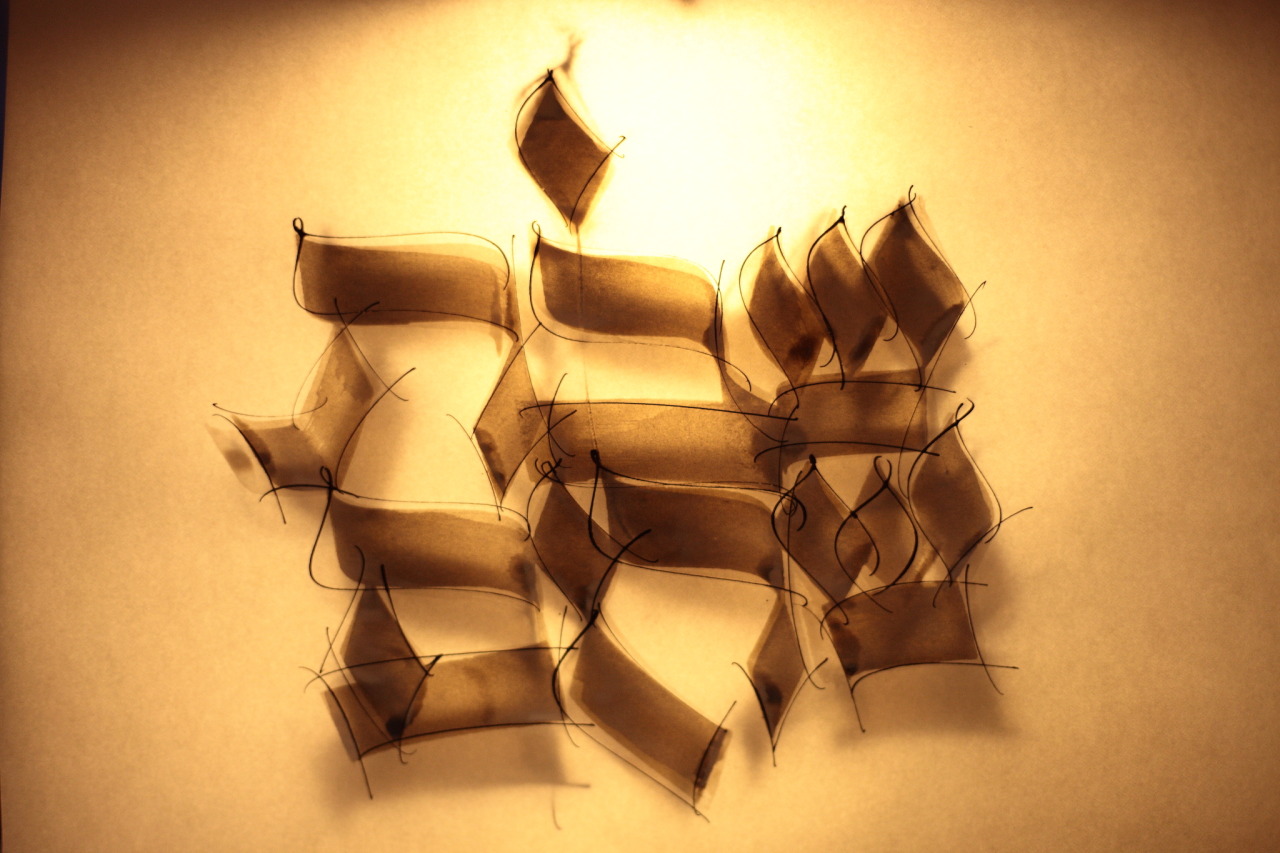 |
| Calligraphy by Michel D'anastasio |
“You can keep every Shabbos to the letter of the law, but unless Shabbos reaches the deepest and highest place in your heart, you haven’t kept Shabbos.” - Rebbe Shlomo
Monday, July 8, 2013
Recognizing the stakes
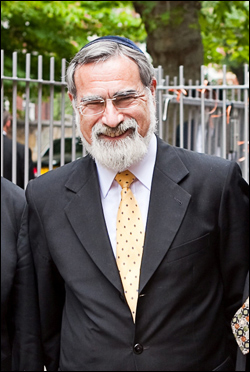
(I'm still not quite convinced that that was indeed the point Rabbi Sacks was trying to make; for starters, the Siyum was anything but monolithic - while under the auspices of the Agudah, the Siyum that I attended had more than a fair share of all types of Jews from all walks of life, many of whom do not subscribe to the Agudist party line, to say the least. Rav Hershel Schachter shlita - who is decidedly not an "Agudist" - was seated in a very nice place on the dais; moreover, a very warm and welcoming forum was provided for the former Ashkenazic Chief Rabbi of Israel, Rav Yisrael Meir Lau, shlita. To present it as an example of anything other than a swell in limmud haTorah is inaccurate.
I think the quote as read was an unfortunately [and uncharacteristic] awkward expression meant to illustrate the growth in numbers of people looking to connect to Torah vis-a-vis those who are growing away from it.
Perhaps a better illustration of the 'massing of extremes' would be the 'other' mega-event that took place a few months prior to the Siyum at neighboring Citi Field, but I digress...)
Still, this is not a new position for Rabbi Sacks. A cursory review of his works - both literary and his efforts as Chief Rabbi - will attest to this principle that he has advocated for years: engaging the world, opening up the universal beauty and wisdom that is Judaism to the other nations of the world, and seeking to elevate us all by celebrating what we have in common rather than focusing on what sets us apart.
This is not necessarily a bad thing, but it does (perhaps ironically in light of the previous statement) highlight a significant difference between different groups of Torah true Jews concerning where our emphases should be.
This is not a novel idea, either. Some might say that this was the Judaism that Rav Shamshon Raphael Hirsch OBM championed, and they might be correct; there is no question that Rav Hirsch's Torah Im Derech Eretz is an attempt at synthesis that worked rather well for German Jewry (But the question remains whether this is an ideal - ab initio - or a response to the needs of the time in the face of existential danger to an entire community.).

Regardless, Rabbi Sack is not suggesting anything radical or innovative. It is one legitimate approach to our mission on this world, an attempt to sanctify and glorify the name of God. But it is one approach among many, including that of the Agudah and others, all of which are valid to a degree, with certain qualifiers.
And both of the two approaches being presented in this false dichotomy are fraught with realistic dangers and concerns.
When Rav Kook spoke at the inauguration of Hebrew University in 1925**, he touched upon this very theme. His speech begins by quoting from Isaiah:
 Citing this second ideal as the hopeful prospect of what the Hebrew University can accomplish, Rav Kook then continues with an exhortation:
v'Ani haKatan - I have so much more to say, as I try to figure this out myself. As I said earlier, there are many approaches, and all have their drawbacks; I certainly don't subscribe to the idea that we should circle the wagons. I don't want to focus on negativity here, but there's a lot of room for improvement for all of us. That should be something to consider during these times...
* See Rakefett-Rothkoff, The Rav vol 2. pages 229-31
** All quotations are courtesy of Leiman, S.Z. Rabbi Abraham Isaac Ha-Kohen Kook: Invocation at the Inauguration of the Hebrew University TRADITION 29:1 (1994); retrieved from here
"Lift up your eyes and look about; they have all gathered and come to you. Your sons shall be brought from afar, your daughters like babes on shoulders. As you behold, you will glow. Your heart will fear and rejoice - for the wealth of the sea shall pass on to you; the riches of the nations shall come to you." (60:4-5)After explaining how the first verse is being borne out with the nascent developments of the Holy Land, Rav Kook turns to the second verse:
But why "fear"? Why did the prophet preface the phrase "your heart will rejoice" with the notion of fear? When, however, we look back in retrospect at past generations, and at the spiritual and intellectual movements that have influenced us, we readily understand that the notion of fear, in conjunction with rejoicing, is appropriate.
Two tendencies characterize Jewish spirituality. One tendency is internal and sacred; it serves to deepen the spirit and to strengthen the light of Torah within. Such has been the purpose of all Torah institutions from earliest times, especially the fortresses of Israel's soul - the yeshivot. This includes all the yeshivot that ever existed, presently exist, and will exist in order to glorify Torah in its fullest sense.This spiritual tendency is fully confident and assured...
The second tendency characterizing Jewish spirituality served not only to deepen the sacredness of Torah within, but also as a means for the propagation and absorption of ideas. It served to propagate Jewish ideas and values from the private domain of Judaism into the public arena of the universe at large...It also served to absorb the general knowledge derived by the collective effort of all of humanity, by adapting the good and useful aspects of general knowledge to our storehouse of a purified way of living.

Here, dear friends, there is room for fear. From earliest times, we have experienced the transfer of the most sublime and holy concepts from the Jewish domain to the general arena. An example of propagation was the translation of the Torah into Greek...There were also instances of absorption. Various cultural influences, such as Greek culture and other foreign cultures that Jews confronted throughout their history penetrated into our inner being...
We gained in some areas and lost in others in our confrontation with foreign cultures. This much is clear: Regarding those circles that welcomed absorption and propagation joyously, with unmitigated optimism and with no trepidation, very few of their descendants remain with us today...[T]he vast majority of them have assimilated among the nations; they found themselves caught up in the waves of the "wealth of the sea"...
Only from those who resided securely in our innermost fortresses, in the tents of Torah, enmeshed in the sanctity of the law, did emerge the truly creative Jews...Among these were many who propagated and absorbed. They exported and imported ideas and values on the spiritual highway that mediates between Israel and the nations. Their attitude, however, toward this undertaking was never one of rejoicing only. Fear accompanied their joy as they confronted the vision of the "wealth of the sea" belonging to the "richest of the nations."Rabbi Sacks' vision is an inspiring, hopeful one, but it needs to be approached with the appropriate wariness and a firm commitment to Torah. While I don't doubt that Rabbi Sacks meets that criteria, we have to take painstaking steps to ensure that when we engage the world around us, it is indeed a confrontation - it may be civil, but we should never let our guard down.
v'Ani haKatan - I have so much more to say, as I try to figure this out myself. As I said earlier, there are many approaches, and all have their drawbacks; I certainly don't subscribe to the idea that we should circle the wagons. I don't want to focus on negativity here, but there's a lot of room for improvement for all of us. That should be something to consider during these times...
* See Rakefett-Rothkoff, The Rav vol 2. pages 229-31
** All quotations are courtesy of Leiman, S.Z. Rabbi Abraham Isaac Ha-Kohen Kook: Invocation at the Inauguration of the Hebrew University TRADITION 29:1 (1994); retrieved from here
Tuesday, July 2, 2013
Recovery
I don't remember hitting the ground; the last thing I remember is the ground rushing up at me, and then nothing.
I can feel the aftereffect of the impact, though. As I pick up my head from the dirt, it all comes rushing over me in a cavalcade of pain. It's like someone crumpled my whole body up like a beer can and then kicked it to the curb.
The smell of topsoil fills my nostrils. My vision is blurry and microscopic granules of grit seem to have covered my teeth in a fine patina of grime.
I need to get up. Now.
I place my skinned palms flat on the ground, trying to ignore their abrasive burn and lift myself up, but I am so, so tired.
I need to keep going. Get up!
The back of my neck prickles as I sense It loom over me, watching, waiting, savoring the moment.
My arms strain, and every fiber of my body screams as I make a half-hearted attempt to pull myself off the ground. If I don't get up now, it's all over.
I know that. I recognize the terrible danger I am in now.
The horrible laugh fills my ears. Get up!
But now that I'm down here, it makes so much sense to just rest...if only for a minute...
It would be so much easier if I could just lay my head back down, close my eyes and slip into a deep sleep...
Rebbe Noson said that more than the actual sin itself, the Evil Inclination waits for the depression that follows it.
It hurts and it's crazy hard, but you must get back up again.
Your life depends on it.
Literally.
I can feel the aftereffect of the impact, though. As I pick up my head from the dirt, it all comes rushing over me in a cavalcade of pain. It's like someone crumpled my whole body up like a beer can and then kicked it to the curb.
The smell of topsoil fills my nostrils. My vision is blurry and microscopic granules of grit seem to have covered my teeth in a fine patina of grime.
I need to get up. Now.
I place my skinned palms flat on the ground, trying to ignore their abrasive burn and lift myself up, but I am so, so tired.
I need to keep going. Get up!
The back of my neck prickles as I sense It loom over me, watching, waiting, savoring the moment.
My arms strain, and every fiber of my body screams as I make a half-hearted attempt to pull myself off the ground. If I don't get up now, it's all over.
I know that. I recognize the terrible danger I am in now.
The horrible laugh fills my ears. Get up!
It would be so much easier if I could just lay my head back down, close my eyes and slip into a deep sleep...
Rebbe Noson said that more than the actual sin itself, the Evil Inclination waits for the depression that follows it.
It hurts and it's crazy hard, but you must get back up again.
Your life depends on it.
Literally.
Monday, July 1, 2013
Asking for help
I don't even know if I have any female readers, but this post is as much for us men as it is for them, especially in the summer months. From PopChassid's blog:
AN APPEAL TO WOMEN FOR MODESTY
Dear women, I have a request.
I just hope you’ll listen. Because I think it’s important.
Anyway, here it is: I would like to ask you to dress modestly.
Now, I know, I know, that this is not something you’re interested in hearing unless you already agree with me about this subject, but maybe you could give me a minute to let me explain myself.
I’ve come to accept something about myself.
That inside of me is something dark. Something disturbing. It’s the evil, conniving side of me.
I think that all people have that side.
It’s what Freud called the Id. It’s what Jews call the “evil voice”. It’s what I call my friggin’ bastard within.
It’s the side of me that doesn’t respect people, that wants to use them. The side of me that tells me I am what matters most in the world, and everyone else is a means to an end. It’s the side of me that turns people into objects. Especially women.
And see, I am spending my whole life working on this side of me. We all are, aren’t we? Anyone that’s trying to become a better person is trying to fight that voice off, to focus on our true selves, the selves that respect others, that sees past the external and into the internal. That respects people as ends to themselves.
And so when people discuss modesty and say that it’s the man’s obligation to work on themselves, to transform themselves, and not the woman’s obligation… I totally agree. It’s my job. I need to respect you no matter what. I need to work not to objectify you no matter what. Even if you’re dressed in a bikini or even, for some reason, running around naked.
But here’s the thing: just like anything in my life, whether it’s not gossiping or getting angry or anything else… I screw up. I screw up a lot. That’s who I am, that’s who (I’m guessing) you are, and that’s who everyone else.
I’m a screwup. It’s my natural state of existence.
I work every day to improve myself, and I hope that today will be better than yesterday and yesterday will be better than today.
But the reality is that no matter what, I screw up. Even on the good days.
And so that’s why I need your help. And if you want to turn down my request, I understand, but I’d like you to at least understand why I’m asking.
Just like it’s much harder not to get gossip when there are people gossiping right in front of me, and just like when it’s much harder not to freak out on someone when they’re yelling in your face… when someone dresses immodestly… it’s just harder for me to not objectify them. To see past the external and into the internal. To me, as to most guys, the dark voice within is suddenly alive, kicking, stronger, when a woman is more undressed than dressed. I fight it, I really do, but the voice is always there.
And I’m aware that this is a fault in me, this is something I need to work on, something I need to fix.
But the thing is, I think that it’s a strength, not a weakness, to admit that I am fallible. And I think it’s also a sign of strength to admit that I need help. And I do need help in this respect, I really do, and I think most men do as well.
If the women of the world helped the men in this respect (and vice versa, by the way… I’m just talking from my own perspective), I think that both people could grow to love and respect each other more. I really believe it can only help.
Because, see, I think this whole debate is put in black and white terms: saying that guys either need to be so perfectly in control of themselves that they never objectify women… or that women are the only ones responsible for the way guys control themselves.
And I don’t think that’s right. I think that there is a middle path in this discussion. I think that when guys demand the obedience of women, and blame women for their transgressions, they are straight up sinning fools trying to avoid their own fallibility.
But I also think that when women reject the idea of modesty, that it comes from a similarly extreme place. A place that puts rights and freedom above all else.
And it’s true: the most beautiful part of living in our society is freedom and rights.
But there is a step that needs to be taken after freedom. A step of partnership. Of dialogue.
And I want you to know, I really want you to know, that this side that’s in me exists within every man, and no matter how much they’ve refined and worked on themselves, they are always going to struggle with it.
And so, even those guys that aren’t asking you to dress any different because they respect you and admire you, are struggling with it, whether they admit it or not. Whether they show it or not.
And so, the best way you can help them, help me, see past the external, straight to your soul, is by dressing modestly. It’s a charity, a giving, a sacrifice.
And you don’t have to make it, of course. I’m sure that most people in your life won’t blame you for not doing it.
And, of course, there will always be women that dress however they want, and so those guys will always have to struggle with that side of themselves. It’s their job, no matter what.
But I honestly believe that you will be doing men, and especially the men close to you, a great service if you do.
Subscribe to:
Posts (Atom)


