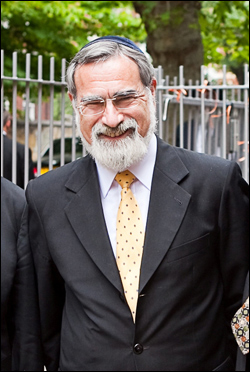
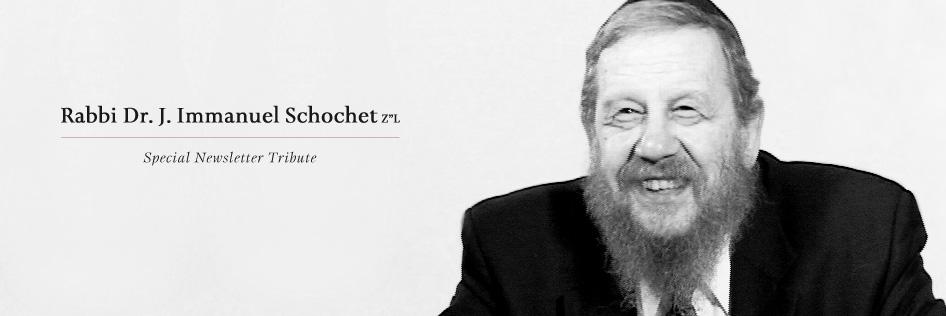
I just found out that Rabbi Dr J Immanuel Schochet passed away this past Shabbos.
Rabbi Schochet was a scholar, a prolific writer, and above all a major chossid who devoted much of his energy - physical and creative - to disseminating the message of the Ba'al Shem Tov through the paradigm of ChaBaD chassidus. Aside from penning several expository works on fundamental concepts of kabbalah and chassidus, Rabbi Dr Schochet also organized many efforts to counter missionary forces intent on proselytizing Jews.
Yehei zichro baruch...
Monday, July 29, 2013
Tuesday, July 23, 2013
Nosson Zand - Believers
I just found this tonight. I've always been a fan of Nosson's, and while this isn't the sound I'm used to coming from him, I dig it.
The Matisyahu feature is a blast from the past - I really miss the beard and peyos (and the yarmulke...). Which makes me wonder: why was Nosson sitting on this for so long?
Love the imagery: the lamplighters stuff at the end, the foam cup thing is pretty cool too...
The Matisyahu feature is a blast from the past - I really miss the beard and peyos (and the yarmulke...). Which makes me wonder: why was Nosson sitting on this for so long?
Love the imagery: the lamplighters stuff at the end, the foam cup thing is pretty cool too...
Friday, July 19, 2013
Internalizing Shabbos
Monday, July 15, 2013
Rebuilding today
"Every generation in which the Temple has not been rebuilt is like the generation in which it was destroyed." - Jerusalem Talmud (יומא פ׳ א,הל׳ א)
What a powerful message that should ring in our ears like the terrible indictment that it is. We're still here. All the things that got us here so long ago are still around now - worse, it seems.
The baseless hatred, the divisiveness, the inability to empathize with the other...
In these past nine days I have tried very hard not to read what is going on in our global Jewih community. Even the period of time when people used to be more sensitive to the elements that are holding us back in this exile seems to have lost its import.
This blog is not about spreading negativity; it is this author's hope that we achieve quite the opposite on a constant basis, and now is no different. In these waning moments before the Ninth of Av commences yet again as a day of fasting and mourning, I beg all of us - big and small, in positions of great and minor influence - to help increase the light.
If you want to fight for a cause or combat a social ill in our community - fine. Please! We need it more than anything! But do it in a way that seeks to enhance the positive aspects, not simply expose the wrongs. More importantly, let's all resolve to work on ourselves and strengthen our more personal relationships with others as well as with ourselves...
Monday, July 8, 2013
Recognizing the stakes
The events surrounding outgoing UK Chief Rabbi Jonathan Sacks shlita and the American Agudah just before Shabbos last week had me quite distressed. On the one hand, the Agudah's response seemed overly reactionary (and verbose), especially in light of our fast approach to the 9th of Av and all the discord that is associated with this especially sad time of the year. On the other hand, after reading Rabbi Sacks' pamphlet, I can't say I particularly blame the Agudah's indignation in response to his using the Siyum HaShas as an example of the burgeoning 'extreme' on the right of an increasingly insular society.
(I'm still not quite convinced that that was indeed the point Rabbi Sacks was trying to make; for starters, the Siyum was anything but monolithic - while under the auspices of the Agudah, the Siyum that I attended had more than a fair share of all types of Jews from all walks of life, many of whom do not subscribe to the Agudist party line, to say the least. Rav Hershel Schachter shlita - who is decidedly not an "Agudist" - was seated in a very nice place on the dais; moreover, a very warm and welcoming forum was provided for the former Ashkenazic Chief Rabbi of Israel, Rav Yisrael Meir Lau, shlita. To present it as an example of anything other than a swell in limmud haTorah is inaccurate.
I think the quote as read was an unfortunately [and uncharacteristic] awkward expression meant to illustrate the growth in numbers of people looking to connect to Torah vis-a-vis those who are growing away from it.
Perhaps a better illustration of the 'massing of extremes' would be the 'other' mega-event that took place a few months prior to the Siyum at neighboring Citi Field, but I digress...)
Still, this is not a new position for Rabbi Sacks. A cursory review of his works - both literary and his efforts as Chief Rabbi - will attest to this principle that he has advocated for years: engaging the world, opening up the universal beauty and wisdom that is Judaism to the other nations of the world, and seeking to elevate us all by celebrating what we have in common rather than focusing on what sets us apart.
This is not necessarily a bad thing, but it does (perhaps ironically in light of the previous statement) highlight a significant difference between different groups of Torah true Jews concerning where our emphases should be.
This is not a novel idea, either. Some might say that this was the Judaism that Rav Shamshon Raphael Hirsch OBM championed, and they might be correct; there is no question that Rav Hirsch's Torah Im Derech Eretz is an attempt at synthesis that worked rather well for German Jewry (But the question remains whether this is an ideal - ab initio - or a response to the needs of the time in the face of existential danger to an entire community.).
Others might try to point to Rav Soloveitchik OBM as another paragon of this type of Judaism - Rabbi Sacks certainly characterizes him as such - but I would humbly disagree on that point as well. True, the Rav lived in the world, embraced it - not only the knowledge, but the culture - but he never seemed to lose perspective as to which was ikkar and which was taful. He earned a doctorate in Berlin, but he never left Volozhin. According to the Rav, there can be no true synthesis between the two worlds; thesis and antithesis must exist independently in order to maintain vitality. A blending would sufficiently weaken both worlds - a tragic occurrence for both.*
Regardless, Rabbi Sack is not suggesting anything radical or innovative. It is one legitimate approach to our mission on this world, an attempt to sanctify and glorify the name of God. But it is one approach among many, including that of the Agudah and others, all of which are valid to a degree, with certain qualifiers.
And both of the two approaches being presented in this false dichotomy are fraught with realistic dangers and concerns.
When Rav Kook spoke at the inauguration of Hebrew University in 1925**, he touched upon this very theme. His speech begins by quoting from Isaiah:
v'Ani haKatan - I have so much more to say, as I try to figure this out myself. As I said earlier, there are many approaches, and all have their drawbacks; I certainly don't subscribe to the idea that we should circle the wagons. I don't want to focus on negativity here, but there's a lot of room for improvement for all of us. That should be something to consider during these times...
* See Rakefett-Rothkoff, The Rav vol 2. pages 229-31
** All quotations are courtesy of Leiman, S.Z. Rabbi Abraham Isaac Ha-Kohen Kook: Invocation at the Inauguration of the Hebrew University TRADITION 29:1 (1994); retrieved from here
"Lift up your eyes and look about; they have all gathered and come to you. Your sons shall be brought from afar, your daughters like babes on shoulders. As you behold, you will glow. Your heart will fear and rejoice - for the wealth of the sea shall pass on to you; the riches of the nations shall come to you." (60:4-5)After explaining how the first verse is being borne out with the nascent developments of the Holy Land, Rav Kook turns to the second verse:
But why "fear"? Why did the prophet preface the phrase "your heart will rejoice" with the notion of fear? When, however, we look back in retrospect at past generations, and at the spiritual and intellectual movements that have influenced us, we readily understand that the notion of fear, in conjunction with rejoicing, is appropriate.
Two tendencies characterize Jewish spirituality. One tendency is internal and sacred; it serves to deepen the spirit and to strengthen the light of Torah within. Such has been the purpose of all Torah institutions from earliest times, especially the fortresses of Israel's soul - the yeshivot. This includes all the yeshivot that ever existed, presently exist, and will exist in order to glorify Torah in its fullest sense.This spiritual tendency is fully confident and assured...
The second tendency characterizing Jewish spirituality served not only to deepen the sacredness of Torah within, but also as a means for the propagation and absorption of ideas. It served to propagate Jewish ideas and values from the private domain of Judaism into the public arena of the universe at large...It also served to absorb the general knowledge derived by the collective effort of all of humanity, by adapting the good and useful aspects of general knowledge to our storehouse of a purified way of living.Citing this second ideal as the hopeful prospect of what the Hebrew University can accomplish, Rav Kook then continues with an exhortation:
Here, dear friends, there is room for fear. From earliest times, we have experienced the transfer of the most sublime and holy concepts from the Jewish domain to the general arena. An example of propagation was the translation of the Torah into Greek...There were also instances of absorption. Various cultural influences, such as Greek culture and other foreign cultures that Jews confronted throughout their history penetrated into our inner being...
We gained in some areas and lost in others in our confrontation with foreign cultures. This much is clear: Regarding those circles that welcomed absorption and propagation joyously, with unmitigated optimism and with no trepidation, very few of their descendants remain with us today...[T]he vast majority of them have assimilated among the nations; they found themselves caught up in the waves of the "wealth of the sea"...
Only from those who resided securely in our innermost fortresses, in the tents of Torah, enmeshed in the sanctity of the law, did emerge the truly creative Jews...Among these were many who propagated and absorbed. They exported and imported ideas and values on the spiritual highway that mediates between Israel and the nations. Their attitude, however, toward this undertaking was never one of rejoicing only. Fear accompanied their joy as they confronted the vision of the "wealth of the sea" belonging to the "richest of the nations."Rabbi Sacks' vision is an inspiring, hopeful one, but it needs to be approached with the appropriate wariness and a firm commitment to Torah. While I don't doubt that Rabbi Sacks meets that criteria, we have to take painstaking steps to ensure that when we engage the world around us, it is indeed a confrontation - it may be civil, but we should never let our guard down.
v'Ani haKatan - I have so much more to say, as I try to figure this out myself. As I said earlier, there are many approaches, and all have their drawbacks; I certainly don't subscribe to the idea that we should circle the wagons. I don't want to focus on negativity here, but there's a lot of room for improvement for all of us. That should be something to consider during these times...
* See Rakefett-Rothkoff, The Rav vol 2. pages 229-31
** All quotations are courtesy of Leiman, S.Z. Rabbi Abraham Isaac Ha-Kohen Kook: Invocation at the Inauguration of the Hebrew University TRADITION 29:1 (1994); retrieved from here
Friday, July 5, 2013
Shabbos meditations...
By Rebbetzin Denah Weinberg, from Aish.com:
Look around. The world is a dark place. People are wandering, roaming the world, searching for meaning. They are trying out this philosophy, that religion. People are groping. Where are the answers? Where is the light?
Light was created on the first day, and the Torah says, "It was good."
It is a woman's mitzvah to light the Shabbat candles. It is a woman's privilege to bring "good" into the world through light. How can those two little flickering candles on my table, light up the big, dark world?
The Shabbat candles usher in the holy day of Shabbat. Thus those little candle lights direct us to a much greater light, the light of Shabbat.
SHABBAT IS A BIG, BIG LIGHT
The light at the end of the tunnel is bright -- it breaks the darkness. Shabbat also breaks the darkness. It is not just a day when we stop working. Shabbat is the Day of the Candles, the Day of Light, the day when we clearly see our purpose in this world. Shabbat is the day on which we see we have a soul.
The soul itself is called a candle -- the candle of God. It is the light of the world. It infuses spirituality into the body and into all materialism. Without this spirituality, the world would be in a state of darkness. It is the soul that connects human beings to God. Similarly, Shabbat is the soul of the week. Without Shabbat, the world is a body without a soul. When women light candles, we welcome that extra light into the world.
Do you know that Shabbat also gives us an extra soul? During the rest of the week, one soul is powerful enough to receive the available holiness. But we need two souls to handle all the extra holiness that enters the world on Shabbat.
It is all too easy to ignore the extra soul and the extra spirituality that is available every Shabbat, and to spend the day just eating and sleeping. We need to ask ourselves, Is this the most efficient use of an extra soul?
I once heard it said that it's much easier to overcome internal conflicts on Shabbat than all week, because during the week the odds are one against one -- one body versus one soul. But on Shabbat, it is two against one -- two souls versus one body. On Shabbat we have a real chance to be more in control.
LIGHT UP THE SOUL
Candles are lit at romantic dinners, aren't they? What makes a dimly lit room romantic? It's the candles -- they draw people together on a soul level. It goes beyond eating a meal together -- that's mundane, that's physical. Rather, its about two humans connecting on a deep, spiritual level. That's exciting. That's romantic! The candles do it.
This, too, is Shabbat. The candles draw us to each other, and they draw us to God. Our soul is drawn to Him and vice versa. Shabbat is a love song. It is romance. It is a date between God and us. (Remember, on Shabbat, don't concentrate on your food -- concentrate on your date!)
We women are the ones who ignite this romance with God. This is what Shabbat candle lighting is all about.
So let's give our mitzvah some thought and put it into its proper spiritual dimension. Do you feel the light on Shabbat? Do you feel your soul light up?
Our tradition gives us guidelines to experience the spiritual dimension of candle lighting. Buy beautiful candlesticks; make sure they and the tray they rest on are polished to emphasize the importance of this mitzvah. Lighting with olive oil is highly regarded because of the intense light it produces. Be dressed in beautiful clothes at candle lighting time and, of course, be on time (18 minutes before sunset on Friday afternoon). Prepare, think, and be focused on this great experience.
SOUL CONNECTION
Our tradition also tells us something remarkable. To help her children fulfill their potential, a woman should feel tremendous happiness when lighting her Shabbat candles. What won't parents do to have good children? They pay high tuition for the best schools; give them extracurricular activities, hobbies, and vacations to stimulate their minds and strengthen their bodies; feed them good, healthy meals; and buy them fine clothes. Yet Jewish sources tell us that one of the most important things we can do for our children is to be careful and happy when lighting Shabbat candles. This is our investment for meriting good, wise, and spiritually fulfilled Jewish children.
Shabbat candles also create peace in the home. How? People enjoy the Shabbat food more with the added light. And there is something deeper. Candles connect people on a spiritual level. Souls don't fight. Bodies fight. Candlelight evokes a soul connection between people, which creates real peace in the home.
Shabbat reminds us that there was a creation and a Creator. Just as Shabbat comes after six days of work, our ultimate connection to God comes in the World to Come -- after years and years of work! This is clarity. This brings sanity.
Human beings ask, What are we living for? The light of Shabbat answers, For an eternity of light, warmth, and closeness to our loving God.
Shabbat is the goal of the week, not merely a rest stop to prepare for the coming week. In truth, we work all week long for this day of pleasure. There is even a tradition to count the days in anticipation of Shabbat. "We're getting there... We're almost there... We're here!" It's like a bride counting the days to her wedding -- not because the wedding will mark the end of her preparations, but because it is the goal.
Shabbat is our goal, our destination. On Shabbat, all difficulties of the previous week change into a new reality. On Shabbat, all pain changes into beautiful, new challenges.
May we light the candles joyfully, carefully, and happily until the world is lit completely with the lights of Shabbat.
Subscribe to:
Posts (Atom)